
Grant Maloy Smith has spent the better part of a decade treating American geography like a research subject rather than a backdrop. Dust Bowl in 2017, Appalachia in 2020, the Mississippi River in 2024, and now the frontier itself, each AMERICAN STORIES album picking one region and building a full historical record around it, songs and now an accompanying illustrated book both. WILD WEST is the most ambitious installment yet by sheer scale, eighteen songs and sixty-seven minutes stretching from the Louisiana Purchase through the Gold Rush, and the ambition shows in who Smith brought in to help carry it.
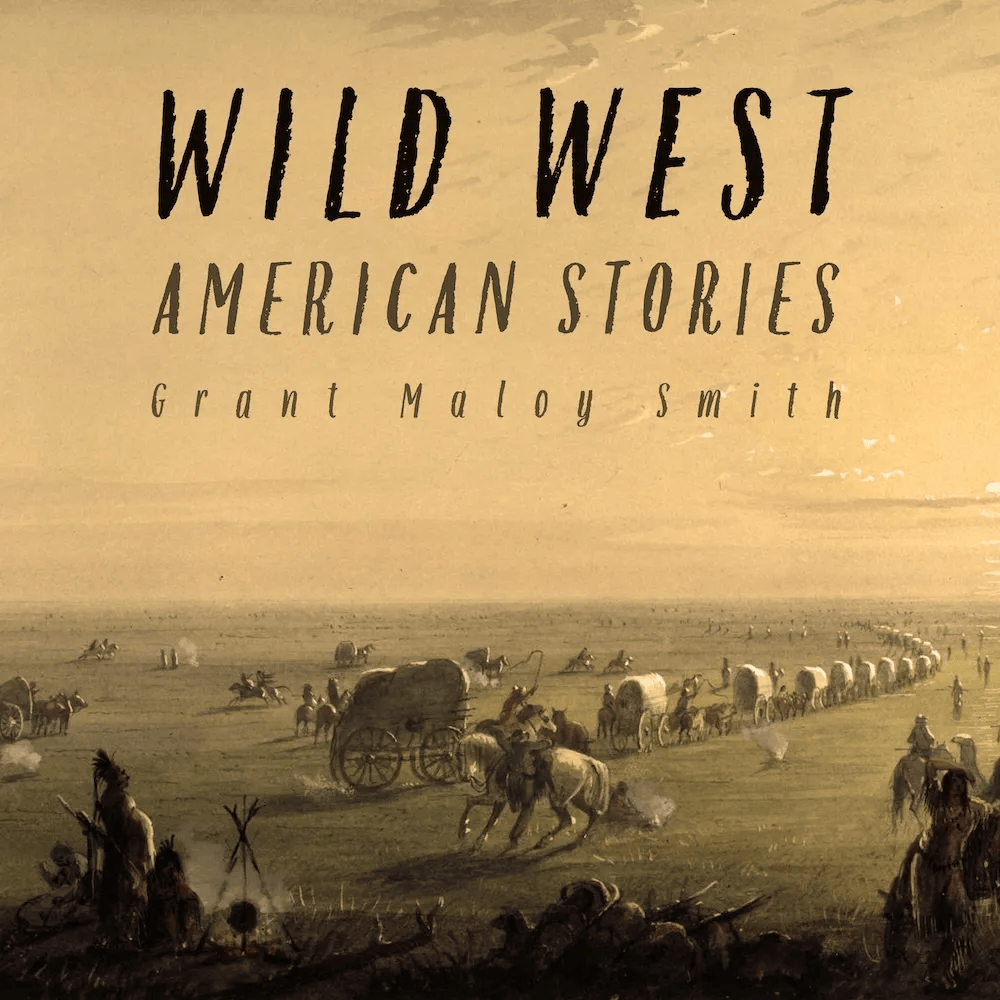
The credits read like a bluegrass and Americana who’s who: dobro player Rob Ickes, who holds more IBMA awards than any instrumentalist in the genre’s history, fiddler Michael Cleveland, a similarly decorated player known for technical command few can match, alongside accordionist Jeff Taylor, banjoist Scott Vestal, and pedal steel player Mike Johnson. That’s not session-musician filler brought in to pad a credits page. It’s a deliberate assembly of specialists, each one suited to a specific regional sound the record needs to convincingly cover as it moves from railroad ballads to saloon waltzes to rodeo stomp.
Opener “Go West, Boys” sets the record’s plain-spoken tone immediately: “the streets are hard, the mud is deep, I’m headed West, I’m on my feet.” There’s no metaphor doing extra work in that line, just weather and distance and the literal act of walking, which suits an album about people who moved west because moving was the only plan available to them. “Voices on the Wind” hands its lead vocal to guest singer Abbie Parker, a choice that shifts the record’s perspective outward from Smith’s own voice early in the tracklist, before “Come and Take It” pulls back into more traditional country-folk ground, guitar picking carrying a narrative about land and the disputes that followed claiming it.
“Tear Trail” takes on the Trail of Tears directly, and its sharpest line, “look at what they done with the wrong end of a gun,” gets its power from the grammar as much as the image. Dropping the standard verb conjugation reads as a deliberate vernacular choice rather than sloppiness, putting the line in a specific voice instead of a narrator’s remove and refusing the kind of elevated language that would turn atrocity into something safely literary. “Elizabeth My Woman” works a similar trick in reverse, mapping grief onto exact geography, “I see you in the sunrise on the wide Missouri plain,” a pattern that runs through the whole record: emotion here rarely floats free, it gets tied to a specific river, plain, or trail marker.
“Gunslinger (The True Story of Bass Reeves)” earns its subtitle. Reeves was a formerly enslaved man who became one of the first Black deputy U.S. marshals west of the Mississippi, and many historians consider him a likely inspiration behind the Lone Ranger legend, a real figure whose story got quietly absorbed into a whiter myth for a century. Giving him his own song, credited by name rather than folded into a generic outlaw narrative, is one of the record’s more pointed historical corrections. “John Henry Holliday” and “El Paso Señorita” lean into saloon and rodeo textures respectively, waltz time and accordion carrying the former, a rockier pulse driving the latter, proof the record can shift tempo without losing the specificity running through the quieter tracks.
Closer “Westward Dreams” ends on a single loaded word choice: “we are pilgrims once again,” reaching back past the frontier entirely to America’s founding mythology and applying it to a different century’s migration. That’s the move the whole record has been building toward, treating westward expansion as one more iteration of an origin story the country keeps retelling itself rather than a self-contained chapter. Smith recorded much of this at his own Suburban Cowboy Studio in Rhode Island, a New England home base for an album chasing frontier myth clear across the continent, with additional sessions completed in Nashville. The ninety-page companion book, written and illustrated by Smith himself, gives each song’s history room the runtime alone can’t provide. Four albums and roughly a decade into this series, Smith has moved past writing songs about American regions and started building an exhaustive archive of them.
WILD WEST: AMERICAN STORIES is available September 18th.


Leave a Reply