
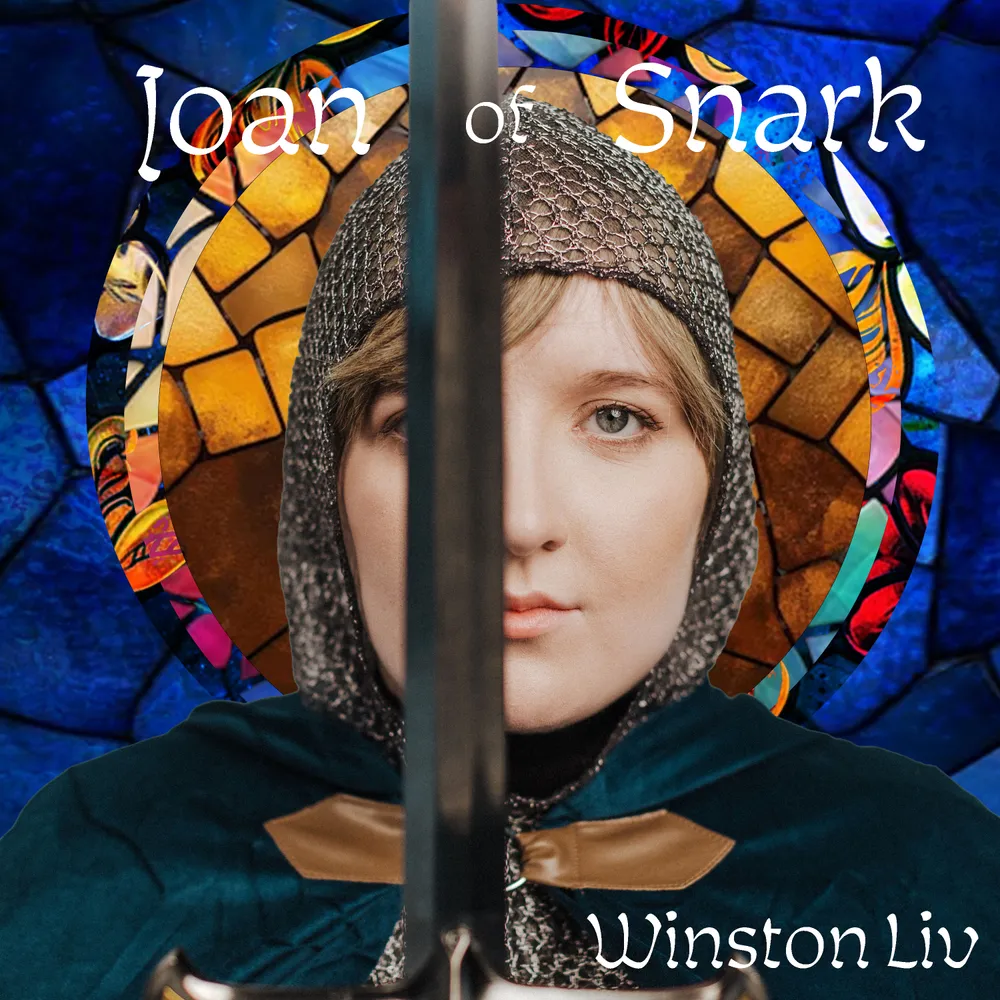
A title built on a pun about Joan of Arc already tells you how Winston Liv plans to handle ordinary teenage experience on this record: borrow the weight of history and mythology, then point it at a crush, a friendship, a body that doesn’t match how the world reads it. “Mr. Montague” pulls a name straight out of Romeo and Juliet. “Werewolf” grew out of Liv’s own senior thesis animated film about the Beast of Gévaudan, the legendary wolf that terrorized eighteenth-century France, repurposed here as a stand-in for gender identity rather than horror. Even “Muse” reaches for “my homeroom Aphrodite” to describe a science-class crush. Across a twelve-song coming-of-age record, Liv keeps treating adolescence as material big enough to deserve Shakespeare and Greek myth, and the trick works because the underlying feelings never get lost underneath the reference.
“Muse” makes that structure explicit in its own verses, tracking one crush across three different grades and three different classrooms: seventh grade science, ninth grade English, twelfth grade Spanish, each verse a small time jump that mirrors the album’s whole coming-of-age arc in miniature. The chorus keeps its ambition modest and its craft sharp, “caught in your orbit, your sun beam,” turning gravitational pull into a crush’s actual physics. What EARMILK called a track more interested in the excitement of having a crush than the ache of missing one gets something right about the song’s engine: the verses build anticipation without ever tipping into the mopey register a lesser songwriter would default to, and the payoff, meeting the crush face to face in twelfth grade only to watch the whole fantasy collapse in real time, lands harder for having stayed light the whole way there.
“Werewolf” trades that lightness for something closer to a reckoning. Written after Liv’s animated thesis film, the song flips werewolf mythology on its head, using transformation as liberation rather than curse: “my body’s a revolution,” Liv sings, and later, “they blame my freedom on the moon,” a line that puts the burden of explanation back on the people who need a supernatural excuse rather than simply accepting a person’s own account of themselves. That’s a sharper piece of writing than a straightforward anthem about acceptance would produce, because the song refuses to wait around for permission rather than simply asking to be understood. The chorus keeps circling one plain claim, nobody knows Liv’s name but Liv, which lands as the album’s clearest thesis statement about identity on a record otherwise mostly concerned with crushes and friendship.
“Sugar Baby” carries the record’s sharpest emotional turn, and its origin story matters as much as the song itself: written about a friendship that only seemed to show up when Liv was paying for things, it was also the demo that got an animation major into a music majors’ songwriting class in the first place, meaning the song that opened Liv’s formal songwriting education is also the one about being taken advantage of by someone they trusted. The gap between that subject matter and the song’s reception, praised elsewhere for its warmth and its “sweet, memorable melody,” points to a real skill running through this whole record: wrapping hard, specific hurt in melodies gentle enough that the difficulty sneaks up on the listener rather than announcing itself.
The rest of the tracklist keeps that same architecture running even without lyrics in hand to confirm it. “Like Like” borrows the exact vocabulary a middle schooler uses to ask whether a crush is real, landing right inside the record’s coming-of-age register by title alone. “Valedictorian” and “Crash and Burn” sit on opposite ends of the same anxiety Liv has described directly, the simultaneous conviction of being destined for greatness and being worthless, achievement and collapse given their own songs a few tracks apart. “Familiar” picks up a word with its own connection to shapeshifting folklore, echoing “Werewolf” from a few tracks earlier whether by design or coincidence.
Joan of Snark closes on “Rock Is Dead,” a title blunt enough to double as commentary on the record’s own hybrid identity, folk and pop and alternative attitude refusing to settle into just one of those boxes. For a debut built from songs Liv started writing in high school, that refusal to pick a single lane, sonically or emotionally, plays like someone finally getting the chance to say everything at once rather than settling for indecision.
Joan of Snark is available August 28th.


Leave a Reply