
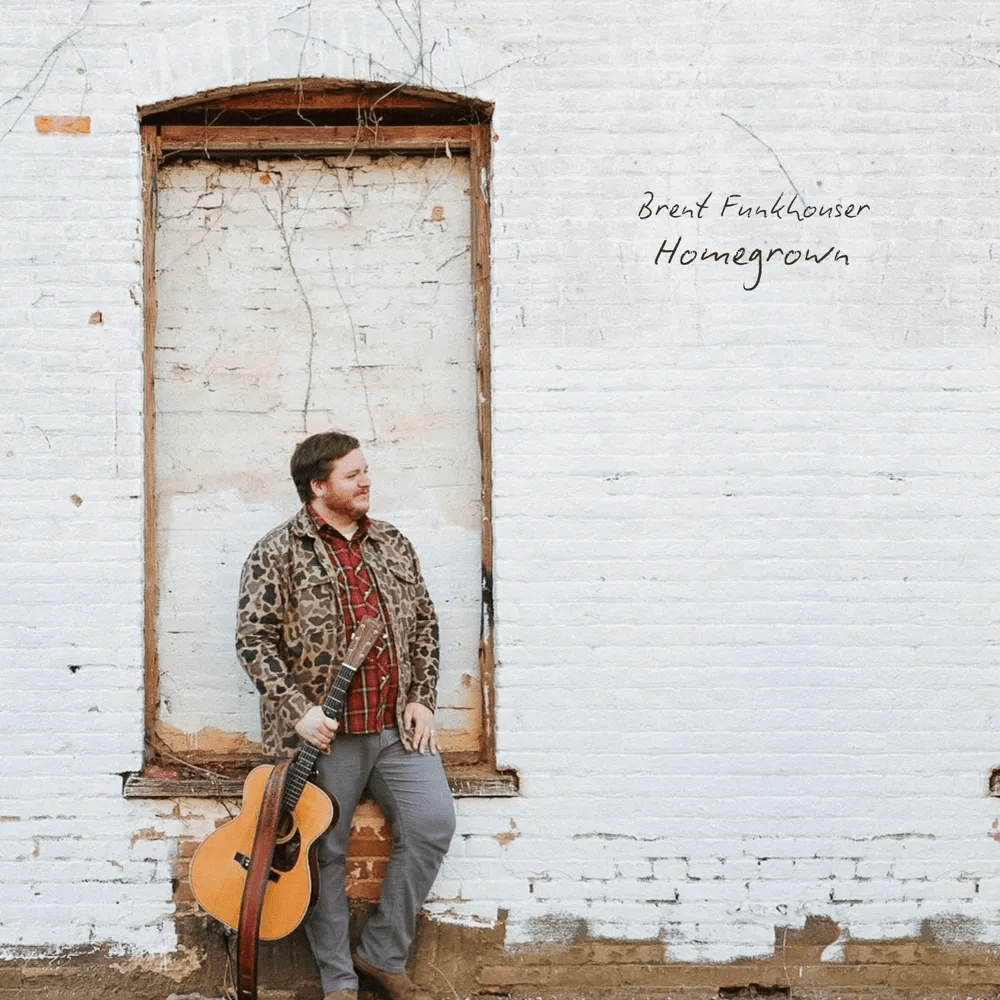
Homegrown was written at Brent Funkhouser’s kitchen table, worked out on his couch, recorded in his basement, and mixed in a spare bedroom, the whole process happening inside the same house rather than farmed out to a studio somewhere else. The title describes exactly that. It also lands five years after Funkhouser’s debut, The Next Karaoke Star, a stretch of time that’s carried a move to a new city, a marriage, and the founding of Red Moon Recordings, the label and concert production company he built around events like The Beltway Opry and The Travelin’ Round. That’s an unusual amount of domestic labor for a nine-song record to carry, but it fits an artist whose songs keep returning to soil, orchards, and the particular ache of loving a piece of land enough to leave it. Funkhouser grew up in Virginia’s Shenandoah Valley and now lives in the DC Metro area, and Homegrown plays like an accounting of what a person keeps and what they lose when they make that kind of move.
Opener “Apple Blossom Time” states the album’s whole argument through an orchard metaphor stretched across an entire relationship. Funkhouser sings about tending a garden together, pulling crabgrass and clover, and then commits past the pretty part of that image straight into decline: “I’ll be with you when we’re long since past our prime, when our fruits’ gone sour, and all our branches bare.” That’s a marriage vow dressed as a farming almanac, promising devotion specifically through the ugly seasons rather than the blooming one. Rebecca Berlin’s three-part vocal harmonies stack behind Funkhouser here with an old-fashioned close-harmony blend, giving the song a lift that keeps the ending’s stark imagery from tipping into gloom.
“Red Moon” carries a different kind of history. Funkhouser wrote it at twenty and built an entire label and merchandise line around its imagery before deciding, years later, that the song itself deserved to grow up alongside him. The new recording keeps Jesse Dean’s slide guitar from the original version while adding Berlin back on harmonies and piano, and the lyric still carries the young writer’s fixation with cyclical time, someone stuck reliving the same ending “back and forth between two major keys.” The song’s narrator is unsparing about his own faults, “I’m a selfish little bastard whose word’s worth shit,” a line that reads like exactly the kind of confession a twenty-year-old would write and a thirty-something would have the nerve to keep. Hearing an artist rerecord his own past self rather than disown it is rare, and it gives the song’s title image, a red moon standing in for one specific unshakeable memory, room to mean something sturdier than nostalgia.
The record’s back half turns from romantic history toward the land itself, with “Nighttime Song” and “A Good Man Is Hard To Find” bridging the gap before it gets there. “Blackberries” was one of two songs, alongside “We Get By,” that built a life as a standalone single before finding a home here, and both tracks carry the loose, lived-in feel of songs road-tested in front of audiences well before they hit tape. That road-testing shows in how settled the arrangements feel, songs that have already been shaped by rooms full of people rather than fussed over alone in a mix session. “Blackberries” leans into that connection to place directly, treating the land itself as a subject worth loving rather than just a backdrop. “Everything’s Fine” turns that same attention toward loss, taking on development, climate change, and invasive species as direct threats to the world Funkhouser grew up in, a rare moment on the record where the personal songwriting opens out into something closer to protest.
“Hearts and Minds,” the album’s other guest feature, pairs Funkhouser with rising country artist Emily Woodhull for a duet built on genuine vocal chemistry rather than a guest verse bolted onto an existing arrangement. Where “Apple Blossom Time” uses Berlin’s voice as texture behind Funkhouser’s lead, “Hearts and Minds” sounds like two equal voices working through the same problem from opposite sides, which suits a song built around connection rather than distance.
By the time the record reaches “Mary, Keep the Faith,” the arrangement has stripped down to just guitar and fiddle, the plainest instrumentation on the whole album saved deliberately for the closing statement. After nine tracks spent moving between inherited history, ecological grief, and hard-won devotion, the simple, direct call toward optimism at the end reads as the record’s actual thesis, earned rather than tacked on. Homegrown never pretends the ground it’s built on is easy to hold onto. It just keeps choosing to hold on anyway.
Homegrown is available July 17th via Red Moon Recordings.


Leave a Reply