
The Exquisite Dream splits cleanly into two halves, and the split is the whole story. Six songs of original material carry the album from digital noise to transcendence, and then the record hands itself over to borrowed voices: a Kurt Vonnegut aside on laughter, a Tommy Douglas speech, a Hubert Dreyfus lecture on perception, and a one-take cover of Neil Young’s “Cortez the Killer” cut on the band’s first day in the studio. That structure only makes sense once you know what this album actually is. Mat Geddes, Darin Steinkey, and Mike Ison played together decades ago in Heijiki and later GiggleBush before drifting apart, and The Exquisite Dream is what happened when they got back in a room together, joined by bassist Owen Sandquist-Sherman, keyboardist Evan Fryer, and lead guitarist Ry Clayton, most of them connected through Victoria’s St. Michaels University School. Five people are rebuilding a chemistry that already existed, recorded entirely on Vancouver Island as what the band calls a hundred-mile album, and the record’s shape follows that logic all the way to its final needle drop.
Opener “Fibre Optics” sets the terms immediately, stacking imagery of light-speed data and viral files against Geddes singing about consciousness bending toward another dimension, before the song undercuts its own cosmic reach with a blunt, almost Cobain-flavored coda: he’s just gonna rock until he’s dead in the casket. That collision, transcendence chased by nihilism, runs through the record’s whole first stretch. “The Naturalist” trades fibre-optic cable for bird migration, using the ouroboros as its central image, a flight path to nowhere that loops back on itself. “What You Want” is where the album’s spiritual language turns political without warning, opening on Buddha nature and unstuck time before Geddes names fascism, war crimes, and genocide directly, refusing the karmic cycle rather than accepting it. It’s the sharpest turn on the record, and Steinkey’s drums keep the song moving fast enough that the anger never curdles into a lecture.
“Walk on Water” and “Shelter” work as a pair, both built around survival imagery, ice that keeps shifting underfoot and a storm that has to be outrun before shelter arrives. “Walk on Water” plays its miracle sideways, staged as a conversation with someone standing out on breaking ice rather than a straight declaration of faith, while “Shelter” pushes through cold and static toward daylight, closing on a repeated nod to the sun breaking through. Both songs earn their optimism by making the listener sit in the cold first.
That optimism peaks on “In the Radiance,” the album’s clearest centerpiece and its most explicit homage. Geddes has said the song carries the imprint of The Tragically Hip’s live energy, and the lyric confirms it directly, naming Gord Downie by way of his effervescence in a verse built around compass directions and released tension. The song folds the album’s title into its own lyric, calls out to Sirius, and ends on an instruction to just drop into the flow, which turns out to be a literal cue for what happens next.
The final four tracks abandon songwriting for documentary. “Get on with Life” borrows Vonnegut’s observation that laughter and crying are physiologically identical responses to the same overload, a piece of found audio that works as a deep breath after “In the Radiance.” “Mouseland” is Tommy Douglas’s own voice, the famous parable about mice who keep electing a government of cats, a piece of Canadian political history that lands as pure conviction rather than commentary. “Phenomenology” excerpts Hubert Dreyfus explaining how the body grasps a situation without needing rules or concepts to guide it, and it functions as a mission statement for a band that wrote this record through improvisation-heavy jams rather than pre-built arrangements. The closing cover of “Cortez the Killer,” recorded live in one take during the band’s first moments in the studio, plays as both a bow to Neil Young and a demonstration of exactly the kind of unrehearsed trust the previous three tracks just spent describing.
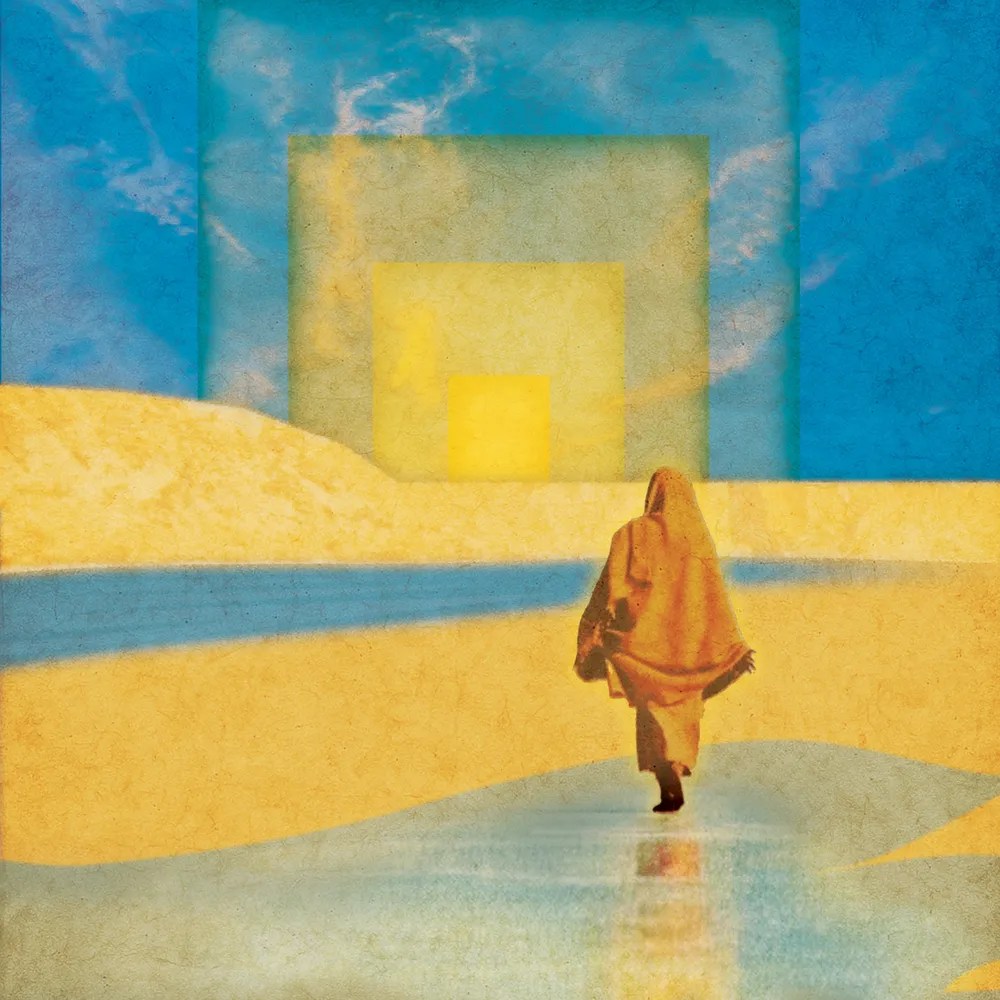
Producer Colin Stewart, working out of The Hive Creative Labs with Geddes and Steinkey handling the album’s own production, gives the record room to breathe without losing definition, a balance that matters on a project this reliant on live chemistry. Steve Turnidge’s mastering keeps that live-off-the-floor feel intact rather than smoothing it into something more conventional. The album’s cover, showing Swami Bikash Giri walking barefoot along the frozen edge of Lake Manasarovar near Mount Kailash, sets the tone before a single note plays: a long, deliberate walk toward something sacred, taken on foot, in the cold, without shortcuts. The Exquisite Dream is built the same way.
The Exquisite Dream is available now on Spotify, Apple Music, and other streaming platforms.


Leave a Reply