
Every compilation record makes an argument, whether the artist intends it or not: this is what mattered, this is the shape it took, this is where one chapter ends. Transmission Coda is Bryan Cooper stating that argument out loud. Twelve singles and two EPs, released across four years while he rebuilt an entire career from a different country, get distilled here into eleven tracks and thirty-two minutes. The title names the exercise directly. A transmission is a signal sent outward. A coda closes the movement before the next one starts. Cooper isn’t reflecting on a career. He’s ending one on purpose, in order to begin another.
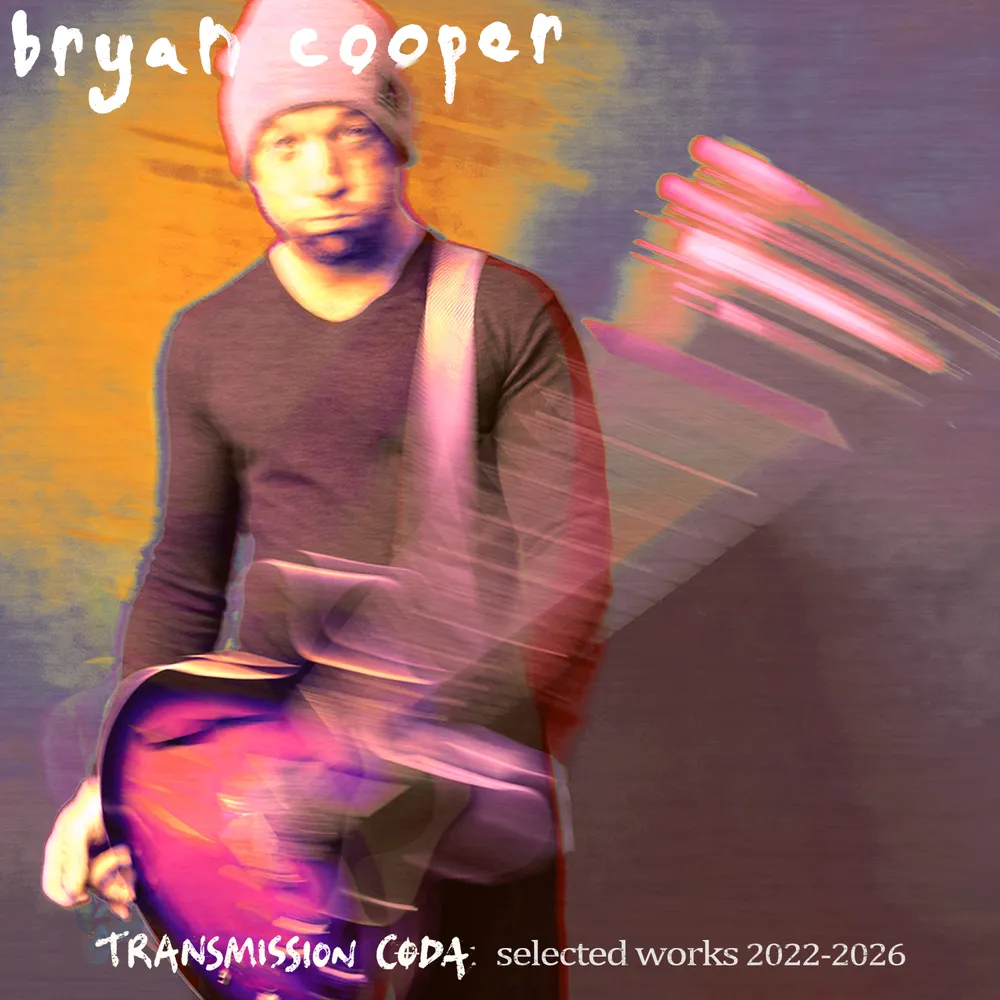
The story behind that ending matters, because it explains why a compilation is the right document for this moment rather than a stopgap. Cooper spent years as a guitarist in UK bands, gigging the way most working musicians do, inside groups with shared history and shared risk. The move to Japan cut that history off completely. Bandmates stayed behind. Rehearsal rooms, local shows, whatever momentum those projects had built, none of it survived the distance. What followed wasn’t a graceful transition. It was a restart: first live shows under his own name in 2021, low-key sets where new songs got tested and reshaped in front of small rooms before they existed as recordings. Cooper has described the shift to solo work as a matter of managing far more at once than a band ever required, every part of the operation now his alone to run. Transmission Coda is the five-year receipt for that work. It proves the plates stayed spinning.
Musically, Cooper writes from inside a specific tradition of British guitar songwriting that treats craft as the whole point: the textured unpredictability of Graham Coxon, the melodic control of Bernard Butler, the widescreen instinct of John Squire, the willingness to break a song’s frame entirely that runs through Jonny Greenwood’s work. His voice, closer to a murmur than a belt, has drawn direct comparison to Elliott Smith. That’s a specific lineage, not a vague one, and it tells you what Cooper values before a single track plays: melody built on real harmonic movement, vocals that trust restraint, and lyrics sharp enough to survive close reading.
Three songs on this collection carry that argument the furthest, and they’ve already been tested in public. “Soma By Drone” pairs a dry, old-radio vocal against full-bodied acoustic guitar, a contrast precise enough that one critic reached for Bach and Segovia in the same sentence as Lennon-McCartney to describe its chord movement. That’s not a compliment handed out loosely, and it places the song’s ambition well outside typical singer-songwriter territory. “Robots On Mute” moves in the opposite direction entirely, a dystopian, high-velocity post-rock track built to hit immediately, praised on release for lyricism dense enough to reward close listening without ever slowing the song down. “Heroes Let You Down” marked the earliest proof that Cooper’s solo run would be worth following, an electric, sharply written single that one outlet flagged in real time as just the first year of a much longer trajectory. Five years later, on a record built specifically to look back, that early call holds up.
Those three tracks alone justify the retrospective. They show a songwriter working in at least three distinct modes, acoustic precision, electric urgency, and lyric-forward songcraft, without any of them sounding like a detour from the others. The other eight tracks on Transmission Coda, from opener “When The Streets Fall Silent” through “Envy,” “Mach 1,” “W.Y.P.,” “Sub Rosa,” “Forfeit,” “Thaw,” and closer “Scars To Armour,” complete a run assembled from material never written to sit together, which is exactly what makes the sequencing itself the real achievement here. Cooper had four years of scattered singles to draw from and no obligation to make them cohere. Compilations built this way usually read as scrapbooks, a pile of A-sides with no throughline connecting one release cycle to the next. That Cooper chose to compile them at all, under a title built around closure rather than celebration, means he’s confident they do cohere, and confident enough to stake the framing of his next record on it.
That confidence is the record’s real subject. Transmission Coda isn’t asking to be judged as a debut album, and it shouldn’t be. It’s a closing statement from an artist who spent five years proving a solo career could hold as much range as the bands he left behind, and who’s now ready to stop proving it and start building something singular. The next record is where Cooper writes one document instead of assembling one. This is what earned him the right to.
Transmission Coda: Selected Works 2022-2026 is available now.
 B-Side Guys
Leave a Reply