
Stephanie Babirak has performed at Carnegie Hall and Lincoln Center, worked with Adele and Phoebe Bridgers, debuted at the Edinburgh Fringe Festival, and played a sound bath in a Brooklyn salt cave. She is a harpist with a master’s degree and a contemporary sensibility who has spent years making the instrument relevant to audiences who didn’t think they were harp people. Rotten Fruit, her new album, brings all of that range to bear on a set of questions that are harder than any venue: what does it mean to be bad, where does badness come from, and how do you see it clearly when you are inside of it?
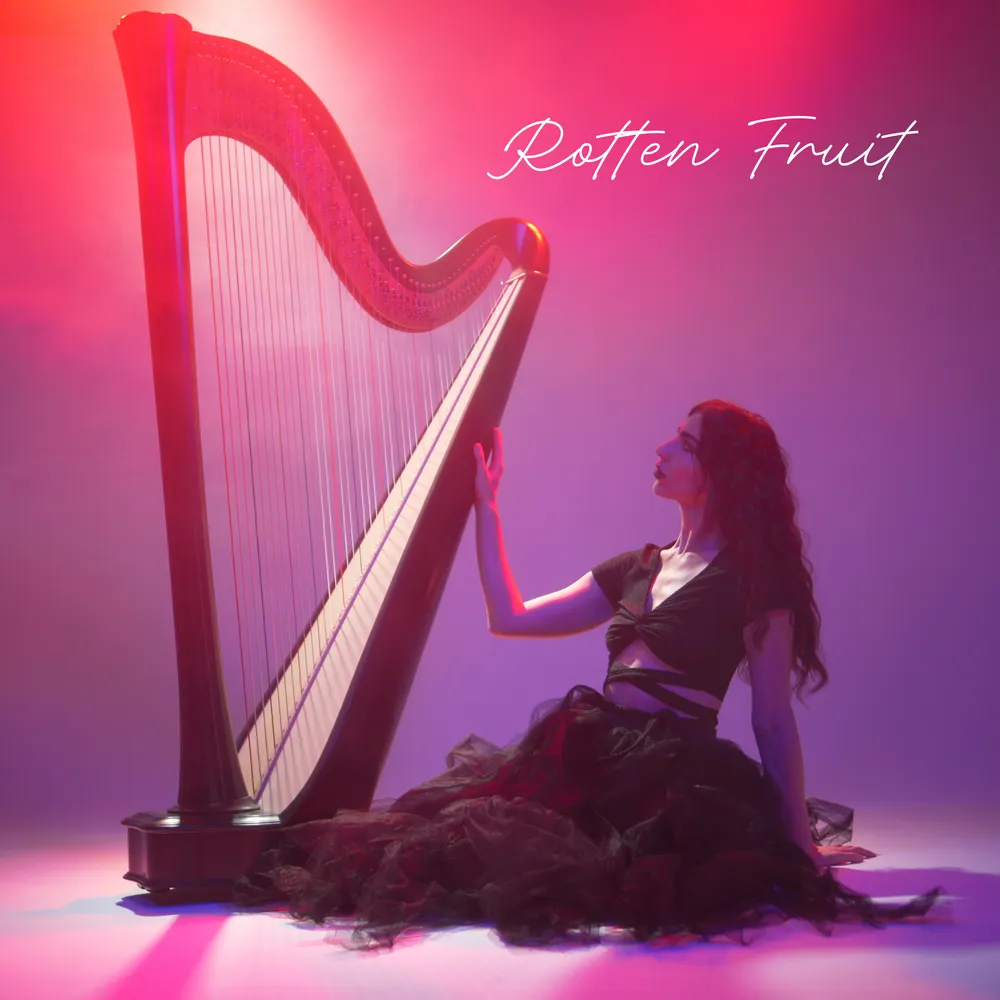
The album’s title comes from the Biblical idea that a tree is understood by its fruit, that what something produces tells you more about it than what it claims to be. Babirak arrived at that framework through “Waterline,” one of the album’s eight tracks, and it spread backwards across the whole record, reshaping what each song was about. The inquiry isn’t about judgment. It’s about attention, paying careful attention to what is actually there, even when it conflicts with what you hoped or believed. That’s a harder project than moralism, and it produces a different kind of music.
The album was written and recorded with Peter Scoma, a longtime collaborator who sings and plays guitar on every track, with Joshua Benash mixing and producing. The resulting sound sits between Lord Huron’s cinematic folk and boygenius’s emotional directness, with Babirak’s harp providing a textural and harmonic layer that neither of those reference points have access to. The classical training doesn’t impose itself. It creates space.
“Apocalypse” is the album’s feature track and its most explicitly political moment. Babirak has described it as a song about living right now, in a political moment that feels surreal and absurd and scary, where everyday life continues regardless of the ambient sense that everything is broken. “We still fall in love, still go to work, still have to take the dog out for walks,” she says of the song’s subject, and the track holds that contradiction without trying to resolve it. Love and connection remaining meaningful even on a sinking ship is not a consolation. It’s a more honest account of how humans actually function under pressure, and the song treats it as such.
“Waves and Whispers” and “Waterline” both carry the water imagery that runs through the album in different directions, the former exploring the pain and beauty of longing and the latter providing the title concept’s origin point. “Hey Cain” positions the album’s moral inquiry within one of the oldest stories about it, the first act of human violence and the question of where that capacity lives. “Lakeside” and “Moon River” bracket the record’s emotional midpoint, the latter title carrying both the Audrey Hepburn association and whatever Babirak does with it to make it her own. “Utah” and “Coda” close the record, the final track suggesting the album’s argument arrives somewhere without fully concluding it.
The harp runs through all of it without announcing itself, which is the harder thing to pull off. Babirak spent years arguing that the instrument could live in the same rooms as contemporary music, and here it simply does, the classical training absorbed into the arrangements rather than displayed above them. Twenty-four minutes is a tight frame for the questions Rotten Fruit is asking. The compression is part of what makes it work.
Rotten Fruit is available now.


Leave a Reply