
The Autochrome Lumière was a colour photography process from the early twentieth century that was technically impressive, enjoyed periods of popularity, and ultimately lost the race to a competing technology. Jakub Tengdahl found the story strangely relatable. That instinct, to identify with the thing that didn’t win, the process that was briefly right and then became socially misaligned, runs through his debut album as Living Too Late with a precision that rewards the attention the record asks for.
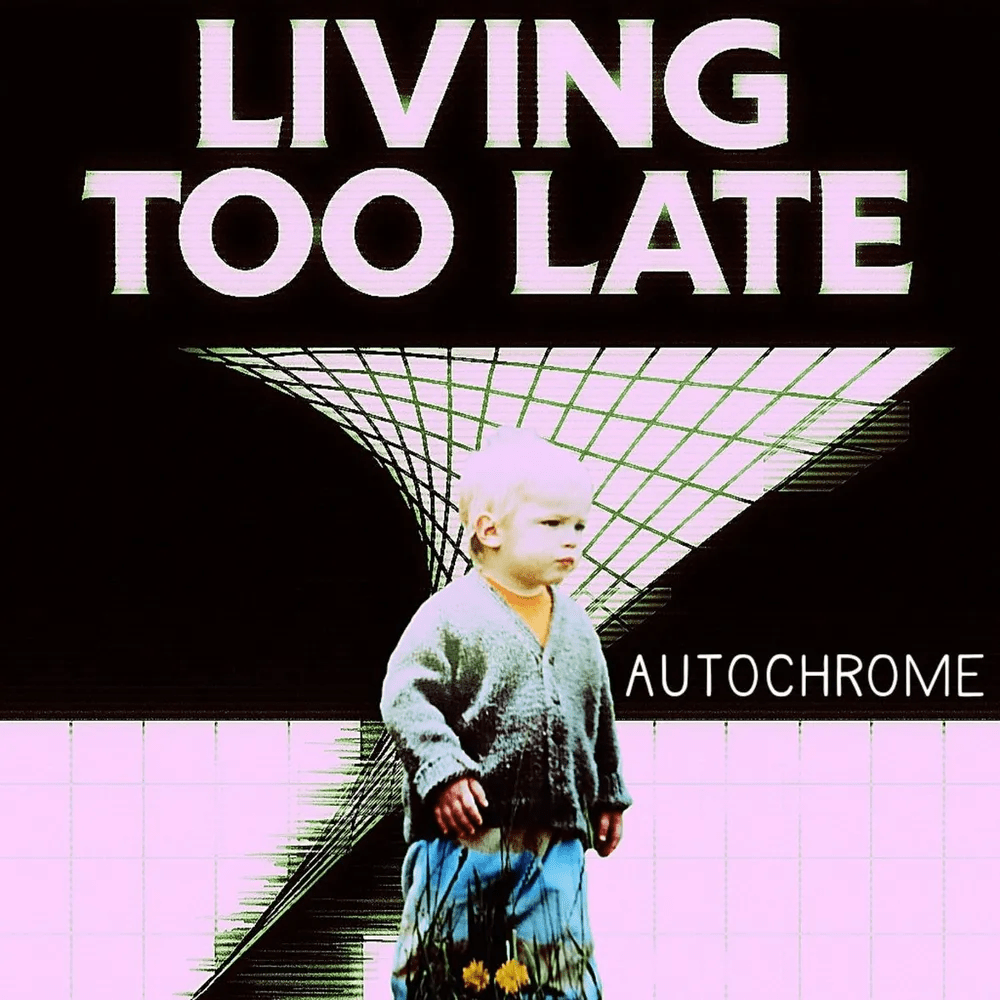
Living Too Late is the solo vehicle of Jakub Tengdahl, who spent years leading South Australian acts DEAN FOREVER and It’s a Hoax, projects that drew from dream pop, jangling guitars, and 1960s songwriting traditions. Autochrome is something sharper and noisier, written, performed, and recorded entirely as Living Too Late, the first time Tengdahl has handled every aspect of an album alone. Inspired by Steve Albini’s philosophy of capturing performances rather than perfecting them, the record favours roomy drums, raw guitars, and first instincts. Several guitar solos survived unchanged from their original demos, because sometimes the first take gets it right.
The title track establishes the album’s sonic logic by moving from an upbeat verse pulse into a heavier downbeat chorus, a contrast Living Too Late borrowed from Something for Kate’s live approach to “Monsters.” The shift works because it mirrors the record’s broader emotional movement, energy becoming weight becoming energy again, the past and present pulling against each other throughout.
“Starting To Be” remains one of the album’s most fully realized pieces, its Sebadoh and Heatmiser DNA present in the mid-90s grain of the guitar and the specific restlessness of a lyric that can’t stop picking at something that should probably be left alone. “The page we’ve started on, it’s starting to be / a cage for what we want, too clever to see” is the kind of line that arrives quietly and then stays. “Erase” follows with more structural ambition, moving through a Sonic Youth-inspired intro, half-time verses, and a wall-of-sound bridge before landing on a major-chord ending that Tengdahl insists everyone deserves, even when the lyrics are difficult.
“Lease Extension” is the album’s most topical track and handles it with the right instincts, taking a Philip K. Dick-inspired approach to the renter experience rather than writing directly about the housing crisis. The anxiety, frustration, and low-level paranoia of waiting on lease renewals and calculating bond deductions gets its surreal treatment, with text-to-speech software appearing in the bridge and outro, inspired by experimental filmmaker Adam Cooley. It’s the record’s most unexpected sonic detour and it works because the strangeness suits the subject.
“Time Waits Pt. 1” and “Time Waits Pt. 2” are built around the same guitar riff pushed in opposite directions, post-punk for the first and krautrock for the second, the repetition appropriate for an album explicitly concerned with nostalgia as a default cultural setting and the persistence of the past. Tengdahl doesn’t claim to have escaped nostalgia himself. The album is honest about being produced from inside it.
“Returning Cavalry” draws on Goethe’s Faust through the medium of loud alternative rock, the math rock and post-hardcore influences Tengdahl was developing alongside his Sebadoh-adjacent work, arriving here in the time signatures and the Jesus Lizard-adjacent physicality of the arrangement. Marshall Berman’s writing on Faust’s overlooked victims, Baucis and Philemon, shapes the lyrical approach, the collateral damage of endless progress examined through the oldest modern story.
“Conduit” is the record’s mission statement in miniature, a call toward less reflection and more action that Tengdahl acknowledges is easier said than done. The song opens economically and then, borrowing a trick from Neil Finn, suddenly opens up into something more adventurous at the end. “Swarm the Anomie” disguises its odd time signatures beneath drums that lock into a repetitive groove, The Fall’s approach to rhythm is applied to math rock’s structural instincts.
“You’re Not There,” originally recorded for a lockdown-era collaborative project, revisits the Pavement-adjacent aesthetic with enough overthinker’s energy to prevent any genuine slacker credibility while still catching something of Stephen Malkmus’s melodic approach. It functions as a needed breath late in the record before “Time Waits Pt. 2” closes the album with a krautrock keyboard line and an outro lead line that Tengdahl traces back to Mi-Sex’s “Computer Games,” which he won on a “Best of the 70s” CD in primary school.
The album that closes Autochrome points back to the beginning of his musical life. An album about time, nostalgia, and the technologies that don’t win the race ends by acknowledging that the past never really stops arriving in the present. Sometimes the first take gets it right. Sometimes you spend decades figuring out what you were trying to say.
Autochrome is available now.


Leave a Reply