
The central tension of Beat Tape is stated in the band’s own description: four humans, no laptops, producing the frequency profile of an electronic record. Organized Grime, a four-piece from Hattiesburg, Mississippi, making what they call Transcendental Southern Psych-Fi, have spent five years as a regional festival fixture building toward this debut full-length, and the record they’ve made is genuinely unusual in the best way. It sounds like a producer’s tape. It was tracked entirely by a live band.
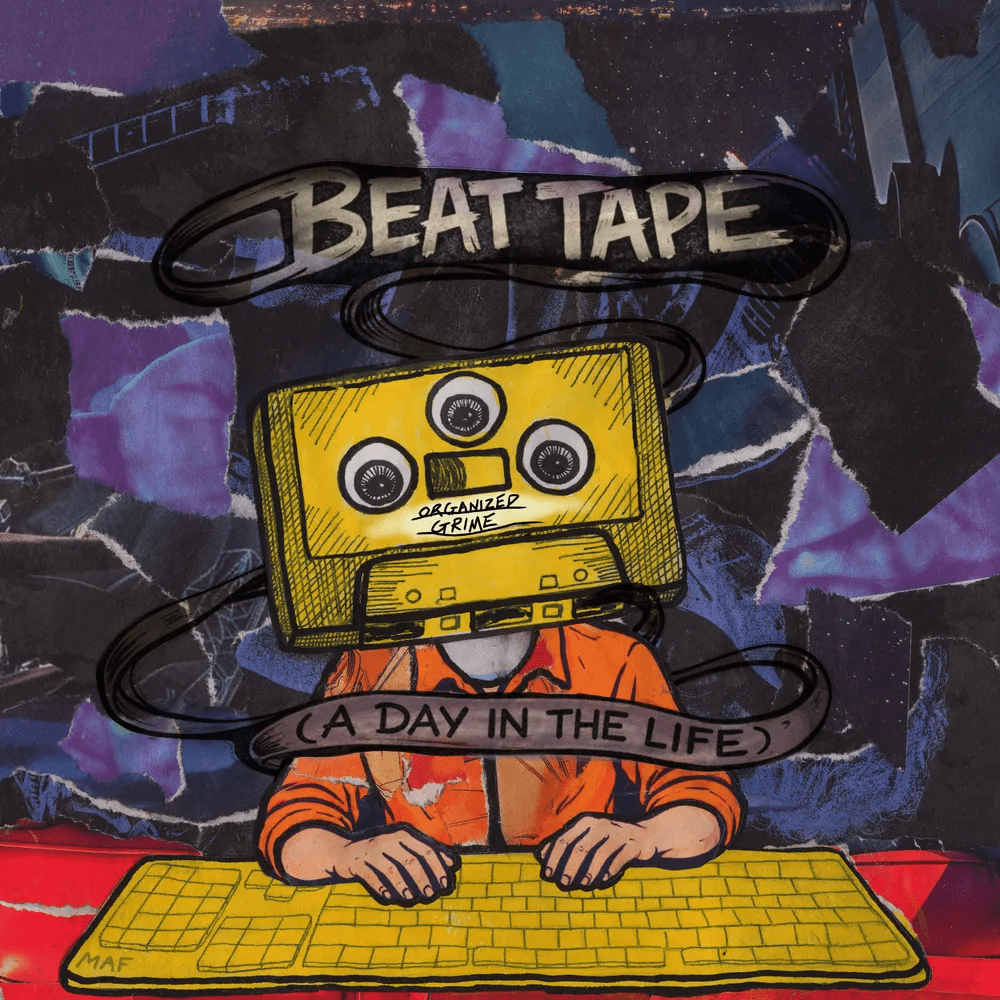
That distinction matters more than it might initially seem. Producer-driven instrumental hip-hop in the tradition of J Dilla, Bonobo, and Khruangbin carries a specific set of textural expectations: the controlled looseness of programmed swing, the deliberate grain of sampled material, the sense of something constructed beat by beat rather than played in a room. Organized Grime’s guitarist Matt Butzlaff, keyboardist and synth player Dell Smith, bassist Marc Haik, and drummer Andy Pate approximate all of that with hands and instruments, which requires a different kind of discipline than programming it in. The swing has to be felt rather than quantized. The grain has to come from the room and the gear rather than the sample bin. That they pull it off across seventeen tracks and thirty-five minutes without the seams showing is the record’s central achievement.
The structure is a day. “WAKE UP” opens things at the obvious hour, a brief threshold before “Beat 1 (The Grind)” settles into the workday groove that gives the first section its title. The interludes scattered throughout, “The Drive,” “SSDD,” “Unwind,” “Dinner,” “The Club,” “The Chase,” “The End,” narrate the passage of time without words, each transition marking a shift in the day’s emotional weather. The sequencing is the album’s narrative spine, and it holds even across seventeen tracks because the interludes are short enough to function as breath rather than interruption.
“Beat 8 (Taradactyl)” arrives early and establishes the album’s psychedelic range, the Deep South gravity that the band name-checks audible in the wide, slow motion of the track. “Beat 3 (Mass in Motion)” and “Beat 5 (Tea Time)” continue the midday stretch with contrasting energies, the former carrying momentum and the latter the kind of late-afternoon looseness the title implies. “Beat 4 (Afterglow)” does exactly what an afterglow should: it holds the warmth of something that just passed without trying to recreate it.
“Beat 2 (Mihály Csíkszentmihályi)” is named for the psychologist who coined the concept of flow, the state of total absorption in an activity where time ceases to function normally. It’s either the most on-the-nose track title on the record or the most accurate, and probably both. By the time “The Club” interlude arrives to mark the evening’s main event, the album has moved through enough tonal range that the transition feels earned rather than imposed.

“Beat 6 (Crash Out)” is one of the album’s two featured tracks and lands with the energy the night-out context demands. The psych-fi vocabulary that runs through the whole record gets pushed harder here, the rhythm section driving while Smith’s keys create the kind of haze that makes a room feel both enclosed and infinite. “Beat 9 (Ghostbeat)” carries a different quality, the title suggesting something more elusive. Where “Crash Out” is present and physical, “Ghostbeat” has the quality of a groove heard from another room, the rhythm there but slightly out of reach, which is an impressive thing to achieve with a live band.
“Beat 7 (Epilogue)” closes the album’s named beats with the reflective quality the word epilogue promises. The interlude sequence “The End” precedes it and does the work of a final transition before the music itself winds down. It’s a considered closer for a record that has moved through an entire day’s worth of human experience without a single word.
The influences Organized Grime cite, Radiohead, The Beatles, Tauk, Phish, alongside J Dilla and Bonobo, account for the range that keeps Beat Tape from settling into a single groove for too long. The psychedelic rock and jazz traditions give the band permission to stretch and develop ideas over time, while the producer-tape template gives the record its discipline and economy. Thirty-five minutes across seventeen tracks is tight editing for a psych band, and the tightness is part of what makes the whole thing work. There is no moment where Beat Tape outstays its welcome, which is harder to pull off than it sounds when the music is this unhurried.
Beat Tape (A Day in the Life) is available now.


Leave a Reply