
The Artemis II mission launched with the weight of renewed collective ambition about what humans might do beyond Earth’s atmosphere. Noah Suarez’s The Aeronaut! arrives in that same moment, asking a different question: what happens to the person who trained for that sky and never got there? The Toronto-based filmmaker and musician spent five years writing and recording this eight-track concept album about an astronaut candidate medically grounded by deteriorating glaucoma and cataracts, left watching colleagues ascend while his own world narrows. The timing is coincidental. The resonance is not.
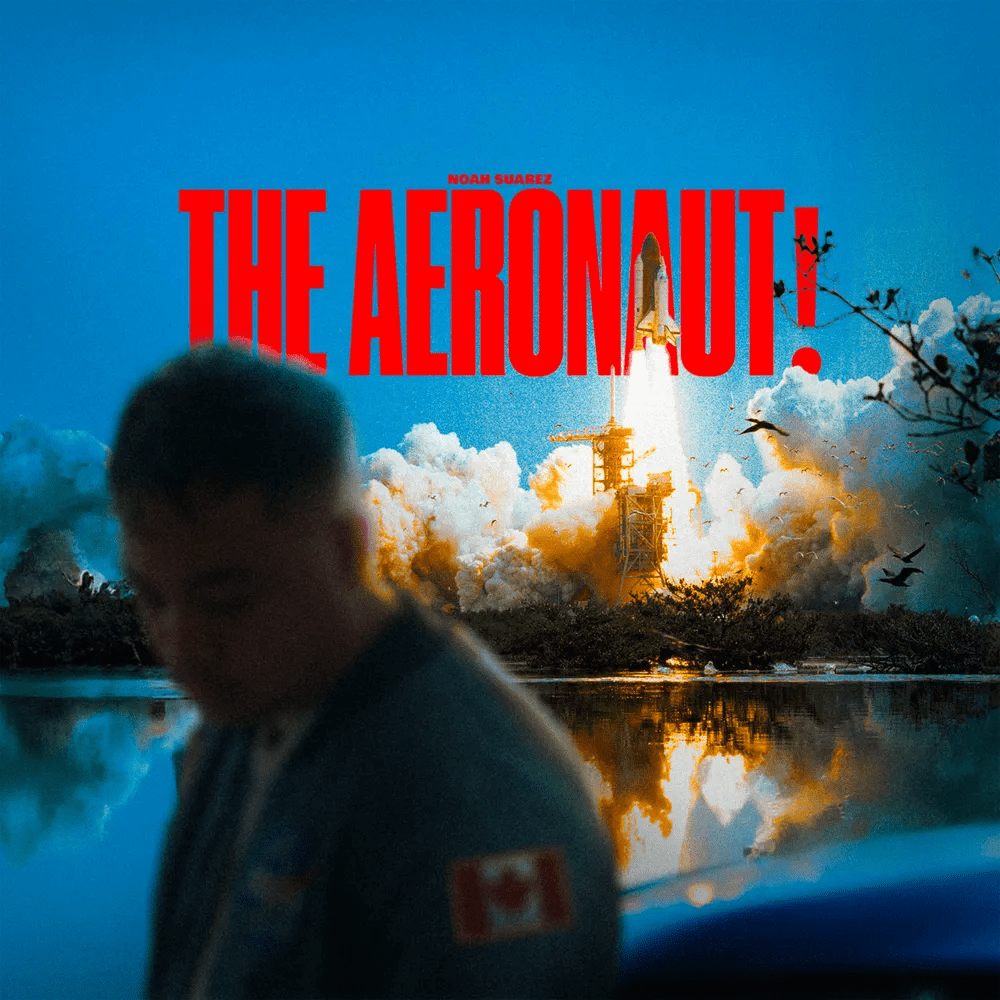
Suarez handled nearly all instrumentation and production himself, building the album’s sonic architecture around a Boss Space Echo, a VC340 synth, and a Fender Meteora guitar. The combination produces what he calls analog futurism, a sound that sits between Apollo-era precision and the messy, out-of-focus reality of a failing body. The choral textures of the VC340 give the record a weightlessness that the subject matter continually grounds. Previous releases placed Suarez in singer-songwriter and folk territory. The Aeronaut! is something rawer and more ambitious, a cinematic rock record that moves with the scope of someone whose day job involves building worlds frame by frame.
“Cataracts!” opens the album with piano before expressive vocals and pulsing guitars carry the narrative to its inciting crisis: the diagnosis that renders the dream seemingly obsolete. The track moves through ambition and reality with a visceral clarity, the “all came crashing down” acknowledgement landing not as melodrama but as the honest accounting of someone who has run through the scenario enough times to describe it without flinching.
“Barrel Rolls in Cameroon” shifts into darker territory, the foreboding vocal tone and debonair guitar twangs conveying self-destruction with a debonair detachment that recalls later-era Scott Walker as much as the Tranquility Base-era Arctic Monkeys the album clearly learned from. “Oh darling, I was falling out the sky” arrives over a rock-forward production that maneuvers between murky intrigue and jangling theatrics, the narrator not yet ready to reckon with what the grounding means.
“A Bonsai That Died In My Arms” brings the album’s first real stillness, the folk-friendly contemplation of “the stars were better in my dreams,” placing the narrator in bed rather than orbit, the proximity of disappointment more intimate than any vast unknown. The bonsai as metaphor works because it doesn’t announce itself: the difficulty of nurturing something fragile applies equally to a dream and a plant, and the song lets that parallel breathe rather than explaining it.
“The Jumpseat” is the album’s most isolating moment, its synth-heavy instrumentation building a sound that suits someone watching from the seat behind the pilot rather than flying. The slowness is deliberate and earned. “Earthbound” then finds the narrator moving through overconfidence and vulnerability into something approaching love, “does she know that all of my songs are written for her?” giving the concept album its most human pivot. The recognition of “I’m better now, with new aspiration” carries the weight of someone who has arrived at that conclusion the hard way.
“Fighting Falcon” drives forward with powerful drums and deep croon-style vocals, the rhythmic momentum a deliberate contrast to the more introspective material surrounding it. “Titanium Space Battleship” pulls the Bowie influence most explicitly, the ghostly vocal commentary and chilly acoustics surrounding a line of startling bathos: “now I dream about a proper tax return.” The distance between that and the infinite possibilities of space is the emotional core of the entire album in a single image, the narrowing made concrete and slightly absurd in the way real disappointment often is.
“Everything!” closes the record with “I could still see the stars, and that’s everything,” the exclamation mark in the title carrying genuine earned hopefulness rather than false resolution. The narrator has not recovered his dream. He has reframed what remains. The distinction matters, and Suarez is precise about it. The stars are still there. The view of them has just changed.
The Aeronaut! is the kind of concept album that justifies the form by making its constraints generative rather than limiting. The story of one grounded astronaut candidate, told through eight tracks built from vintage-analog and futurist gear in a Toronto studio over five years, turns out to be a story about how humans negotiate the gap between what they reach for and what they’re given. That gap is where most lives are actually lived. Suarez has made a record that sounds like what it feels like to stand in it.
The Aeronaut! is available now.


Leave a Reply