
Folk music breathes memory. Across six spellbinding tracks, Queensland’s Jo Davie doesn’t just tell stories—she conjures ghosts, builds sandcastles, and plants seeds in cemetery soil. Her debut EP “Nothing Comes Free” emerges not as mere introduction but as fully-formed artistic statement from an artist who earned her University Medal and First Class Honours the hard way: by understanding that technical brilliance means nothing without emotional truth.
“Throw Me A Rope” opens the collection with aquatic imagery that floods the senses—a voice that undulates between whispered confession and controlled power, guitars simultaneously fuzzy and precise. Davie positions the listener in purgatorial waters, neither safely harbored nor released to open sea. This liminal space becomes the perfect metaphor for relationships suspended in painful uncertainty.

The path winds to “Cemetery,” where Davie transforms what could be morbid territory into sacred ground. Twinkling guitar notes and violin strokes paint a landscape where mourning broken relationships finds unexpected beauty. Her academic background surfaces in the architectural precision of the arrangement, yet nothing feels clinical—each element serves the emotional core with mathematical exactitude that paradoxically creates space for messy human feelings.
When “Sandcastles” arrives third in sequence, Davie’s compositional intelligence becomes apparent. This International Songwriting Competition semi-finalist provides necessary contrast—brighter in tone, allowing sunshine to penetrate the previous tracks’ intimate shadows. The drums stake territory in indie-rock Australiana while Davie examines loss through ephemeral structures destined for dissolution by inevitable tides.
“Say The Word” marks the collection’s boldest departure, opening with vocoder harmonies that transform the human voice into something celestial before introducing church-like synthesizers. This technological experimentation feels purposeful rather than trendy—digital tools deployed to explore devotion’s strange physics, where a single syllable could inspire eternal commitment. The production reinforces the lyrical premise: how ancient emotional patterns survive in our modern contexts.
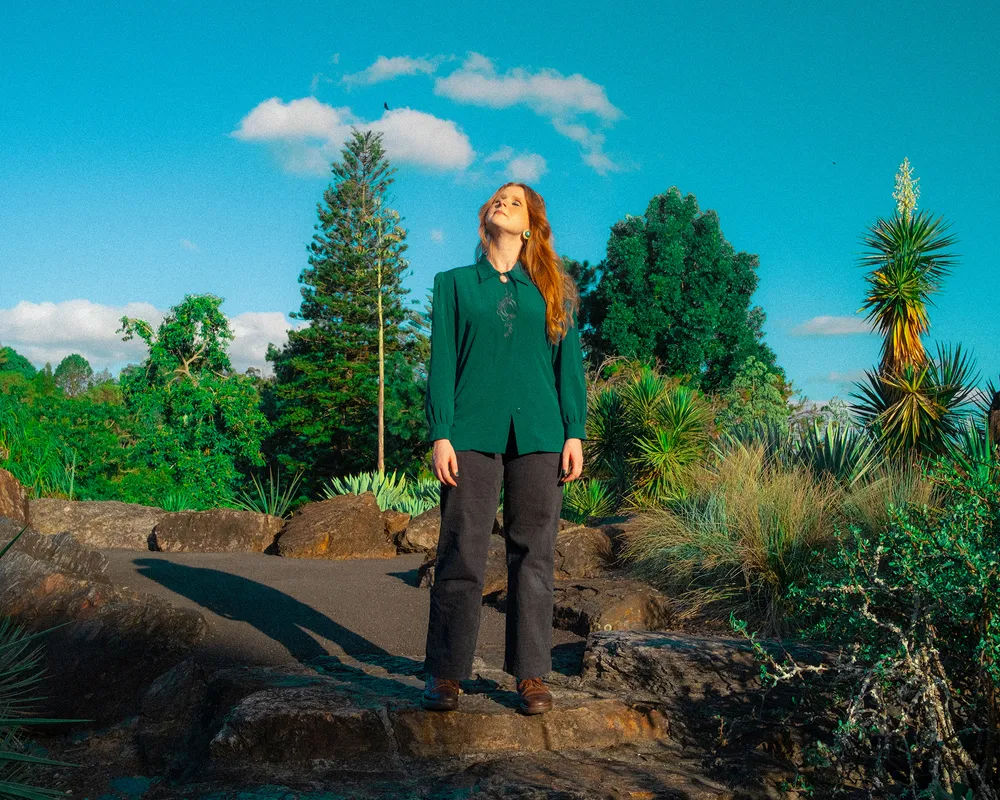
With “Colder,” Davie returns to folk-pop foundations but resists comfortable familiarity. Her voice—simultaneously powerful and vulnerable—creates intimate space for examining what flourishes in absence. The arrangement feels like memory itself—recognizable yet subtly altered by time’s passage and emotional distance.
The closing title track transforms from gentle guitar meditation to cathartic release through an electric solo that elevates melancholy toward something approaching transcendence. This sonic evolution mirrors the song’s thematic arc: moving from anxiety about future outcomes toward presence in the immediate moment. The accompanying music video, filmed by Caleb Colledge on Stradbroke Island/Minjerribah during golden hour, translates these musical ideas into visual poetry—Davie moving through landscapes charged with personal history while singing about finding peace exactly where you stand.
Throughout these six compositions, Davie demonstrates why she’s captivated audiences at Woodford Folk Festival and earned the Carol Lloyd Award—she understands that nothing comes free, especially not artistic authenticity. Every note here feels earned through lived experience rather than calculation. In navigating these waters alongside Davie, listeners receive a rare gift: stories that transform individual experience into universal resonance without sacrificing an ounce of specificity.


Leave a Reply