
Christo Sedgewick opens his third album with a myth. “The Dead King Hunts and Eats the Gods” draws from Egyptian cosmology, a dead pharaoh ascending to devour the gods and absorb their power, and Sedgewick renders it with blues-soaked harmonica and twang-heavy guitars that treat ancient imagery as naturally as if it were a highway or a kitchen table. “The sky is a drinking bowl spilling out blood / the King’s in the river now spitting out mud.” The swampy, electrified pulse of the track announces something important: this is an album that reaches for old forms and old stories not out of nostalgia but because those forms still carry weight when the right material is put inside them.
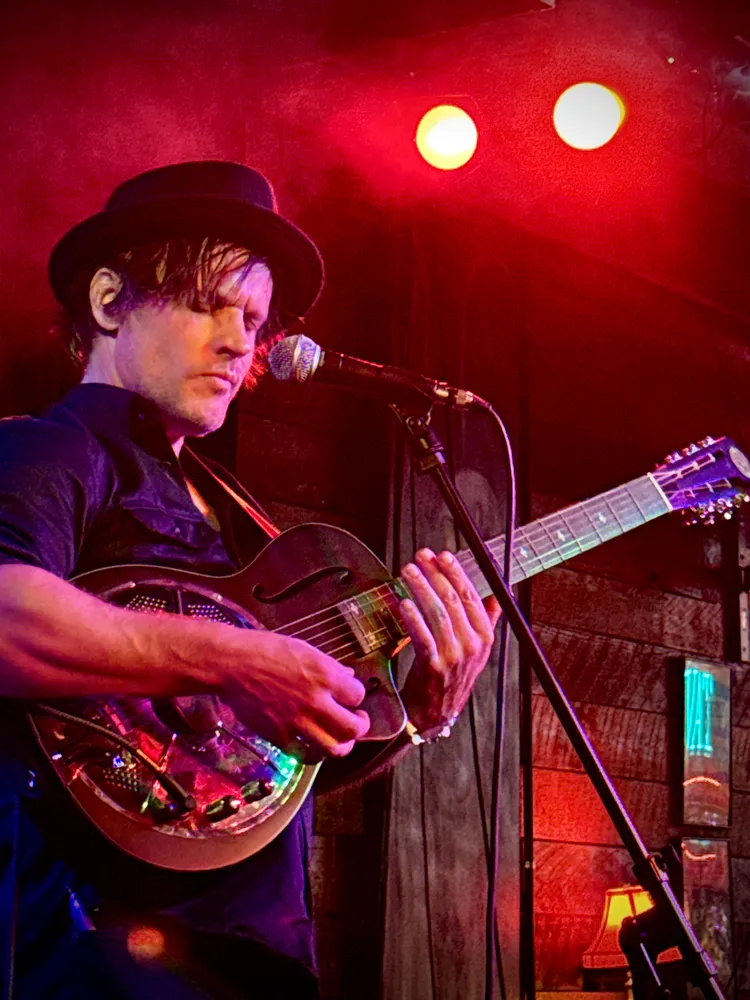
Sedgewick was born in a textile mill town along Maine’s Androscoggin River and now lives in Chicago, with stops in Boston, Portland, and Seattle in between. His third album, The Lonesome Tender Hollow Of The Night, is the most fully realised expression of the Americana and blues direction he’s been moving toward. Early influences in poetry, particularly the pantoum form with its emphasis on repetition and evolution, show up throughout the lyrics in lines that return and deepen with each pass. He records with low wattage tube amplifiers rather than effects pedals, letting the natural character of his instruments carry the tonal work. The result is warm, unvarnished, and immediate in the way that approach almost always produces.
“Highway 12” follows the opener with a complete change of register, cinematic and tender, where the first track was gritty and driven. “I can’t tell you what I need / I’m so tired but I can’t sleep / I only know I’m living when I’m leaving” is the kind of lyric that earns its plainness through the specific imagery surrounding it: whisper trees standing below like burning bones of wooden soldiers, hearts the size of hand grenades exploding in moonset reveille, a body spilling outside itself. The geography is real and the emotional weight is real and the song holds them together without forcing a resolution.
“Bowen” is the album’s most nakedly beautiful moment, a love song built on the phrase “there’s rivers in the beauty of your eyes” that uses the natural world as both subject and metaphor without letting one swallow the other. The title track phrase appears here: “In the lonesome tender hollow of the night.” It’s a song about the kind of love that feels like a landscape, vast and particular at once.
“Yellow Bird” pivots hard into something rawer, five hundred dollars and a hole in a pocket and a finger in an electrical socket, the sensation of love rendered as physical shock. “I heard a yellow bird singing this morning / think he’s singing about love / turns out he was crying / cuz his wing wasn’t working” is the best kind of lyrical misdirection, funny and devastating in the same breath.
“Election Blues” is one of the album’s most quietly devastating tracks, a narrator repeatedly stepping outside, finding the world too heavy, and going back to bed. “I just can’t stand watching man invent his own death,” and the hours ticking by toward a wasted afternoon, the march he can’t bring himself to join, the letter he might write later. It’s a song about political exhaustion that refuses to be polemical about it.

“Lodestone” shifts toward something closer to a benediction, a list of instructions for how to live: never dim your light, speak kindly to strangers, remember you are also worth saving. “Even when your lodestone heart bleeds dark as Doom” is a line that earns the capitalisation through sheer commitment, and the song’s gentle, repetitive structure gives the words room to function less as advice and more as a reminder.
“Jaws” is where emotional stagnation gets its fullest treatment. “My heart is in your jaws / you’re the shine in the crow black night / you’re the ruby in the diamond mine / you’re the song singing in the pines when the wind blows down the line.” The images pile up with the quality of someone trying to articulate something that resists articulation, the obsessive return to a person through every landscape. “Paper Birds” moves through darker, more abstract territory, paper birds withering in the river where they light, echoes banging around in the hollows of bones.
“Blue Jay” provides the release that the album has been building toward. A blue jay laughing from a tall birch tree delivers a sermon: God is where yourself’s in line with everything else, where you reach out your hand when your neighbor needs help. It’s the album’s most overtly hopeful moment, and it lands because the preceding nine tracks have earned it. Closer “Splice” ends things on a more cryptic note, a bottleneck and a Cadillac and a red post meeting point, the album’s mythological undertow surfacing one final time.
The Lonesome Tender Hollow Of The Night is the work of a songwriter still actively learning and still actively reaching, which is the only condition worth making a record in.
The Lonesome Tender Hollow Of The Night is available April 30.
 B-Side Guys
Leave a Reply