
There’s a particular kind of artistic freedom that only comes from having spent decades not caring whether the industry is paying attention. Kris Dane has had that freedom for a long time. The Antwerp-born singer-songwriter, once part of dEUS’s original lineup and later Ghinzu, has spent twenty-plus years building a body of work that refuses categorisation, moving between folk, soul, and Americana according to the logic of the songs rather than the logic of the market. His ninth album, a self-titled record released on [PIAS] Recordings, is the most concentrated expression of that independence yet.
To make it, Dane packed his car, drove his entire family from Belgium to rural Nottinghamshire, and spent two months living what he describes as feeling like the inside of a film. He recorded at Superfly Studios in Ollerton with producer Jamie Evans, an old friend whose involvement began almost accidentally: Dane visited simply to play him some new songs, Evans started playing along, captured one track on an old cassette machine, and the course of the album was set. The core ensemble is small, comprising Evans, modular synth player Wim Daans, Klara Finder, Florentina Finder, and Paul Stone, and the intimacy of that group is audible throughout. Dane brought an old Neumann U47 microphone from home and played guitars that included one from Evans’s family, the kind of detail that sounds minor until you hear how the record sounds.
The decision to leave the rhythm section behind is the album’s most structurally defining choice. Dane wanted everything wet and deep to come primarily from Daans’s modular synths, and the result is a record that breathes differently from anything with a conventional drum track underneath it. Several pieces stretch toward the eight-minute mark, not as a statement about attention spans but because the songs required it. Dane has cited The War on Drugs as proof that long tracks can still connect, but the comparison only goes so far: where that band builds toward euphoria, Dane builds toward something quieter and more interior. The album’s pace is its argument.
“Cherry” opens the record with warmth and a kind of principled gratitude. Dane has described it as being about the common things that connect us all, having loved ones and a place called home, and the lyric “why ever wish for more than glory” carries the weight of someone who has genuinely arrived at that conclusion rather than performing it. The piano ballad quality of the track drifts above the everyday noise in exactly the way the press materials promise, and it sets the album’s emotional register clearly from the first minutes.
“Beyond The Wall,” the lead single, explores the boundaries we build for ourselves with warm acoustic guitars underpinned by meditative percussion and glowing backing vocals. It is raw without being ragged, hopeful without being naive. “Joy” builds around minimalist instrumentation and Dane’s warm, soulful voice, its poetic imagery of cracks, scars, skin, and flame opening a quiet contemplative space where joy arrives not as exuberance but as something more like recognition. “All Things Beautiful” and “Carob Tree,” the latter a love song, continue the album’s exploration of the ordinary made sacred, the same territory Dane identified in the daily toll of the Dunham Bridge, in a Double Decker eaten late at night, in the church bell at Ollerton recorded for the album while the team rarely left the studio.
The record’s landscape conditions are inseparable from its sound. Dane drove forty minutes each day through Nottinghamshire countryside to reach the studio, and he’s certain it seeped in even though the songs were already written. “Hourglass” closes the album with the weight that a closer implies, the title carrying the record’s concerns about time and attention and what we choose to spend them on. At forty-five minutes across eight tracks, the album asks for full engagement and rewards it.
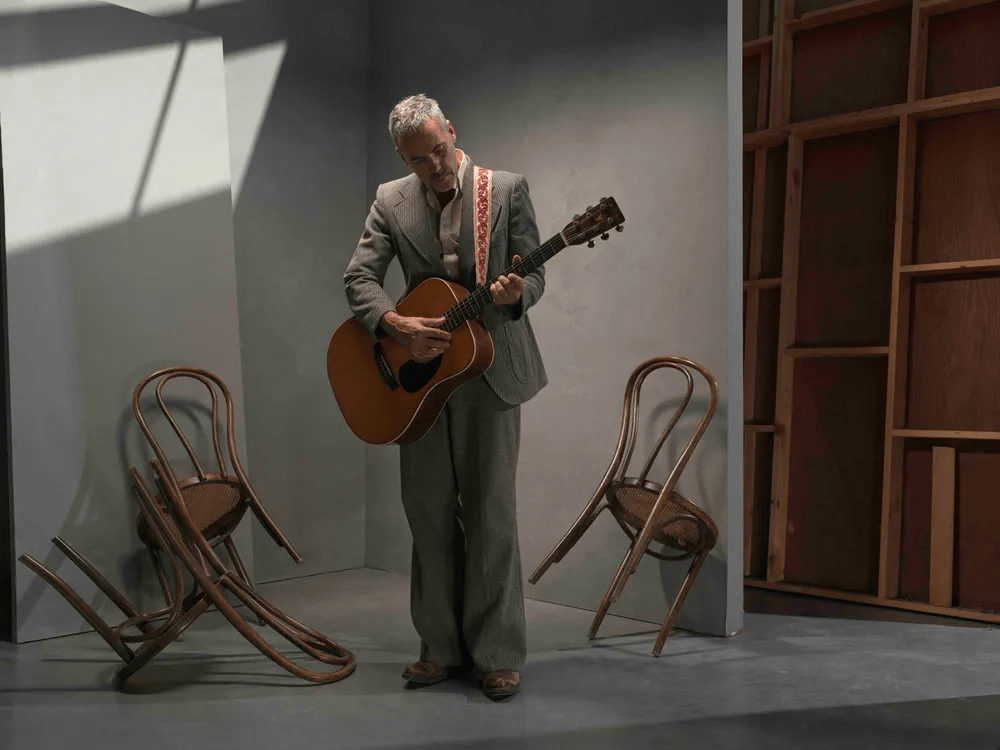
Dane has been described as one of Belgium’s most gifted yet underrated artists for long enough that the phrase risks becoming its own kind of cliché. What the self-titled album does differently is refuse to treat that status as a problem requiring a solution. He says plainly that he has never adjusted to the zeitgeist and wouldn’t know how, but he also senses a counter-movement forming, more openness, fewer boxes. The record isn’t positioned as a bid for belated recognition. It’s positioned as the next thing, made by someone on a mission, which is the only condition under which Kris Dane has ever been able to work.
Kris Dane is available now on [PIAS] Recordings.
 B-Side Guys
Leave a Reply