
Some betrayals arrive dressed as happy endings. Haunted Like Human’s “Married in Savannah” dissects the particular heartbreak of watching someone you once knew become exactly who you hoped they’d never be, wrapped in the kind of folk arrangement that sounds like memory itself.
Dale Chapman’s vocal performance carries the weight of someone delivering a eulogy for the living. Her Northwestern directness cuts through any romantic sentiment about change or growth, instead presenting transformation as a kind of death. The way she delivers lines about stained glass casting faces “in shades of blue” suggests both wedding day beauty and suffocation—the visual poetry of someone disappearing behind their own choices.
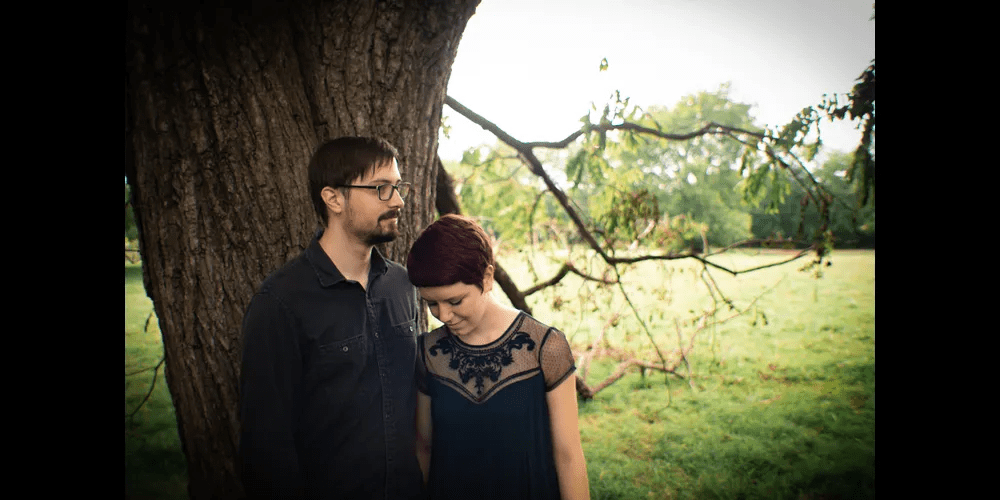
Cody Clark’s guitar work provides the perfect counterpoint to Chapman’s stark observations, with fingerpicked patterns that echo classic Americana while maintaining enough restraint to let the narrative breathe. The production wisely avoids overwhelming the intimacy, creating space for Chapman’s storytelling to unfold without interference. There’s a lived-in quality to the arrangement that suggests these musicians understand the difference between performing sadness and documenting it.
The song’s emotional architecture builds through accumulated detail rather than dramatic revelation. Each verse adds another layer to the portrait of transformation—from family rebellion to Southern conformity, from bathroom haircuts to chapel ceremonies. Chapman’s imagery works because it avoids judgment while still mourning what’s been lost. The repeated phrase “what a shame to see a wild thing be tamed” becomes both observation and lament.
What makes “Married in Savannah” particularly compelling is how it treats growing up as potential tragedy rather than inevitable progression. The bridge’s questioning—”Are you just growing up and growing out of it?”—suggests that maturity and capitulation might be indistinguishable, at least from the outside. There’s no villain here, just the slow erosion of possibility.
Chapman’s background in prose and poetry serves the song well, as her lyrics avoid the easy metaphors that often plague folk storytelling. Instead, she presents concrete images—dashboard photographs fading in summer heat, wall maps and spinning dreams—that accumulate into emotional truth. The song understands that sometimes the people we lose to happiness are the ones we mourn the longest.
 B-Side Guys
Leave a Reply