
There’s a particular ache that lives in the space between desire and fulfillment, a restlessness that drives us toward horizons we can’t quite name. Rah Rah Rabbit understands this geography intimately, mapping its contours across nine tracks that refuse to settle into comfortable categories. Chasin’ Rabbits, Catchin’ Squirrels arrives as a debut that sounds like the work of a band that’s been wrestling with these questions for years—which, in many ways, they have.
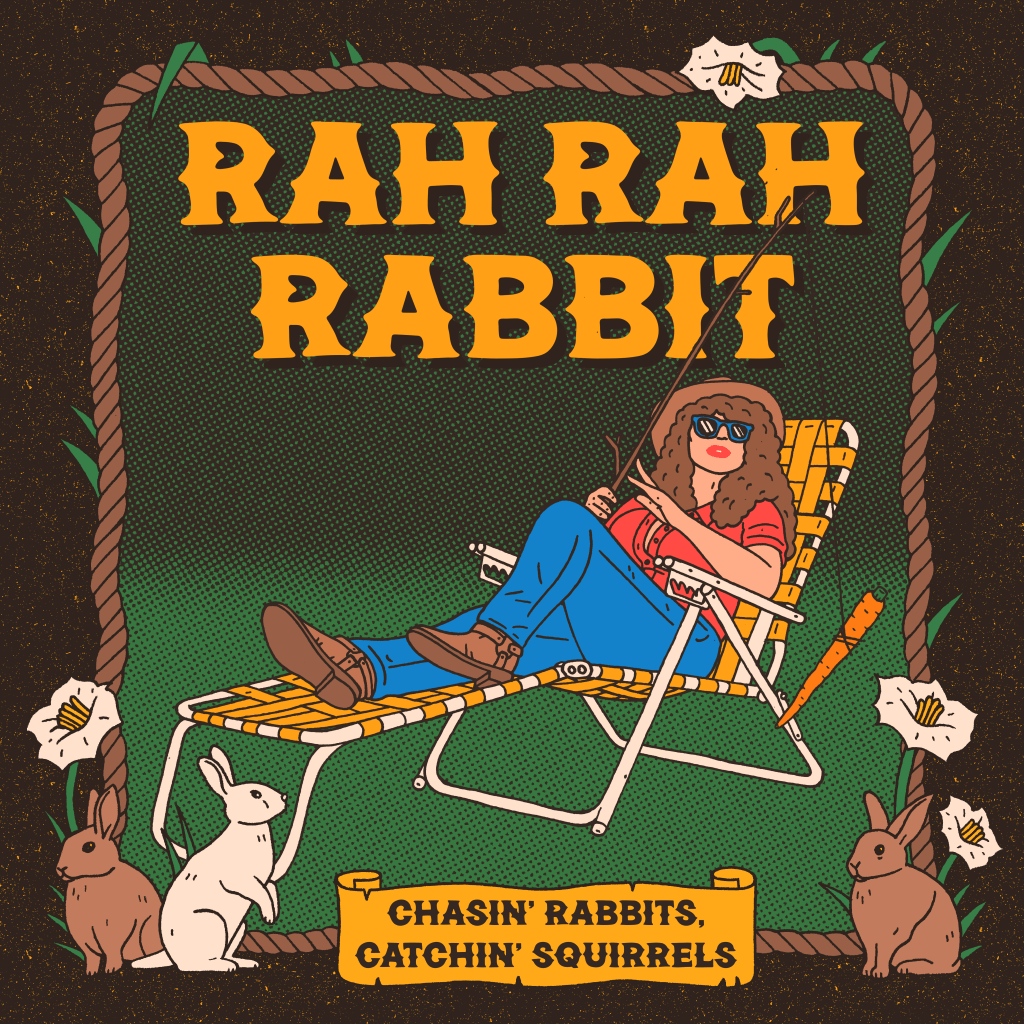
The album opens with “Liquor Store Chicken,” a title that immediately establishes the band’s gift for finding poetry in the mundane. The track sets up the record’s central tension: the collision between cosmic ambition and earthbound reality. Rabbit’s voice carries the weight of someone who’s learned that getting what you want doesn’t always solve the problem of wanting itself. Her delivery has a weathered quality that speaks to the fifteen years she’s spent crafting songs in Los Angeles and the Mojave Desert, but there’s nothing worn-down about the performance—instead, it suggests someone who’s refined their understanding of how disappointment and hope can coexist.
The production across Chasin’ Rabbits, Catchin’ Squirrels demonstrates a sophisticated understanding of how different textures can serve narrative purposes. When the band locks into their honky-tonk mode, the bass lines become anchors that keep the songs tethered even as the arrangements threaten to float away. The electric guitar work provides bite without overwhelming the delicate interplay between fiddle and lap steel, instruments that serve as the album’s emotional compass. These aren’t mere genre signifiers; they’re storytelling tools deployed with precision.
“What it Means” and “A Man I Once Knew” showcase the band’s ability to navigate genre shifts without losing coherence. The former builds around a rhythmic foundation that invites movement while the lyrics explore the complexity of understanding—both self-knowledge and the challenge of truly knowing another person. The latter demonstrates how the band’s folk roots inform their approach even when the arrangement suggests cosmic country expansiveness. Rabbit’s songwriting here reveals someone who understands that the most profound truths often emerge from specific, lived experiences rather than abstract philosophizing.
The album’s middle section—”When You Get It,” “Mountains,” and “This Winter”—forms a trilogy of sorts, examining different aspects of arrival and aftermath. “When You Get It” directly addresses the record’s central theme: the peculiar emptiness that can follow achievement. The arrangement supports this thematic content brilliantly, with the harmonies from Rabbit’s bandmates creating a sense of fullness that somehow emphasizes the song’s exploration of emotional vacancy. “Mountains” expands the scope, using physical landscape as metaphor for internal terrain, while “This Winter” grounds the existential questions in seasonal imagery that feels both specific and universal.
The band’s versatility becomes most apparent in how they handle transitions between moods and styles. Rather than feeling like a showcase of range for its own sake, these shifts serve the album’s exploration of restlessness and searching. The psychedelic elements that creep into certain tracks don’t feel like departures from the Americana foundation; instead, they suggest the natural expansion that occurs when traditional forms encounter contemporary consciousness. This is cosmic country in the truest sense—music that uses familiar structures to explore unfamiliar territories.
“Checkered & Blue” represents one of the album’s strongest individual tracks, demonstrating how the band can create memorable hooks without sacrificing lyrical complexity. The song’s visual imagery—the checkered and blue of the title—provides a concrete anchor for more abstract emotional content. Rabbit’s vocal performance here shows remarkable control, knowing exactly when to push and when to pull back, supported by arrangements that create space for every element to contribute meaningfully.
The album’s final stretch—”Feels That Way” and “Windy Feet”—brings the thematic exploration full circle without providing easy resolution. “Feels That Way” acknowledges the subjective nature of experience while refusing to dismiss the validity of personal truth. “Windy Feet” closes the record with imagery of movement and departure, suggesting that the searching itself might be the point rather than any particular destination.
What makes Chasin’ Rabbits, Catchin’ Squirrels particularly compelling is how it balances accessibility with depth. The melodies stick, the rhythms compel physical response, and Rabbit’s voice provides a consistent thread throughout. Yet repeated listening reveals layers of meaning that reward attention. This isn’t music that needs to announce its intelligence; it earns respect through the accumulated weight of its insights.
The album succeeds because it understands that the best country music—cosmic or otherwise—emerges from the tension between acceptance and ambition, between finding peace with what is and maintaining the courage to imagine what might be. Rah Rah Rabbit has created a debut that honors tradition while expanding possibilities, offering songs that satisfy immediate desires while planting questions that linger long after the final notes end. In exploring the eternal human condition of wanting what we don’t have and questioning what we do, they’ve made an album that feels both timeless and urgently contemporary.
 B-Side Guys
Leave a Reply