
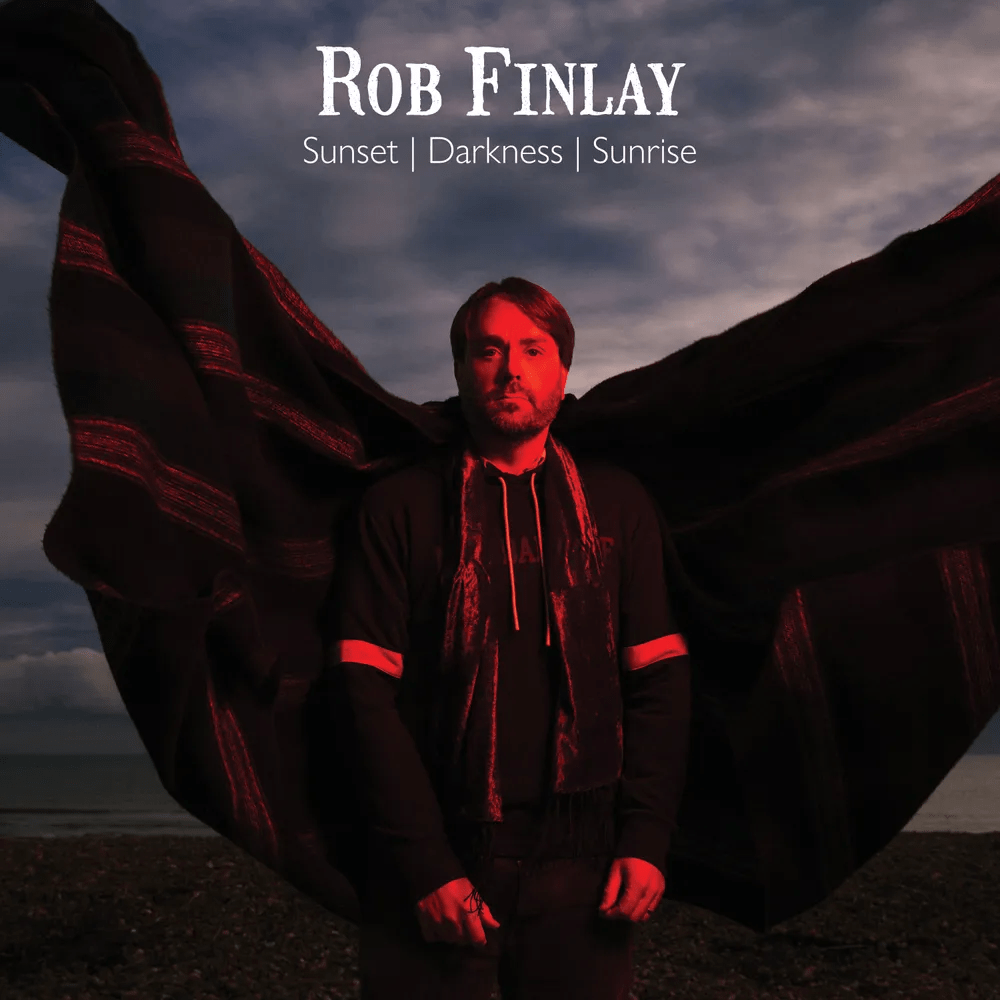
Some artists document grief as frozen moments; others trace its evolution. With his new EP “Sunset | Darkness | Sunrise,” Rob Finlay chooses the latter path, crafting an emotional triptych that transforms personal heartbreak into universal catharsis. Released May 2nd, these four songs—functioning as conceptual suite rather than disparate tracks—reveal a songwriter willing to travel through darkness toward hard-earned light.
The EP opens with “All Eyes Surrender,” establishing both narrative foundation and sonic template. Finlay’s voice—simultaneously vulnerable and authoritative—moves through octaves with remarkable control, floating above Geoff Holroyde’s precise drumming (borrowed from Feeder) and Oscar Golding’s nuanced bass work (known for his contributions to Rag’n’Bone Man). The arrangement creates perfect scaffolding for lyrics exploring that initial moment when love’s dissolution becomes undeniable. When Finlay sings of surrender, you hear both resistance and eventual acceptance in his delivery—a duality that remains present throughout the collection.
Lead single “Afterglow” emerges as the EP’s emotional centerpiece for good reason. Already featured on BBC Introducing and over 90 radio stations, the track transforms heartbreak’s aftermath into something approaching transcendence. Patrick Murdoch’s guitar work (session musician for Beyoncé) provides ethereal texture rather than mere ornamentation, while Mac Adams’ keyboard contributions create cinematic depth that enhances rather than distracts from the song’s emotional core. Producer Adrian Hall (Tori Amos, Depeche Mode) demonstrates remarkable restraint, allowing silent spaces between notes to become as impactful as the sounds themselves.
What elevates “Afterglow” beyond mere breakup ballad is Finlay’s willingness to examine loss without self-pity. His lyrics acknowledge pain without wallowing, creating emotional authenticity that explains why the song has connected with listeners across platforms. The chorus—rising from gentle verse with controlled urgency—creates the rare moment where musical and emotional climax align perfectly, explaining why audiences find themselves singing along despite the song’s deeply personal origins.
“Ballerina,” slated as the second single, marks the EP’s darkest moment—the “wilderness years” referenced in Finlay’s conceptual framework. Jo Silverston’s cello (known for work with Frank Turner and Keane) and Sue Lord’s violin create haunting counterpoint to Finlay’s increasingly desperate vocal delivery. The classical instrumentation serves narrative purpose, suggesting formal structure imposed upon emotional chaos—much like the ballet metaphor central to the song’s lyrical conceit. This track particularly showcases Finlay’s gift for finding beauty within struggle, a perspective perhaps informed by his personal journey through permanent hearing loss in one ear.

Closing track “In White” provides necessary resolution without resorting to simplistic happy ending. Amyee Weir’s backing vocals—entering for the first time in the collection—create a sense of community emerging after isolation, perfectly complementing lyrics exploring rediscovery of love and peace. The arrangement builds methodically toward cathartic release that feels earned rather than manufactured, with Andy Baldwin’s mastering (Elton John, Oasis) ensuring every instrumental voice receives perfect placement within the final mix.
Throughout these four songs, Finlay demonstrates rare ability to transform personal experience into art without sacrificing emotional authenticity. The “concept record” approach succeeds because it traces genuine emotional trajectory rather than imposing artificial narrative. His voice—emerging from the tradition of Jeff Buckley and Tim Buckley before him—navigates both technical challenges and emotional nuances with remarkable precision.
What’s particularly impressive is how Finlay has transformed potential career limitation—his sudden sensorineural hearing loss—into creative strength. Like Ludwig van Beethoven or Brian Wilson before him, his perseverance through auditory challenge has seemingly sharpened his compositional focus rather than diminishing it.
“Sunset | Darkness | Sunrise” arrives as Finlay’s most cohesive artistic statement yet, building upon the critical acclaim of his debut “These Words Aren’t Meant for Me” while charting bold new territory. The EP confirms Tom Robinson’s assessment that Finlay transcends simple “singer-songwriter” categorization, instead occupying space alongside artists unafraid of emotional complexity and sonic exploration. Through these four meticulously crafted songs, Finlay doesn’t merely document heartbreak’s journey—he transforms it into art that illuminates our own paths through darkness toward eventual light.
 B-Side Guys
Leave a Reply