
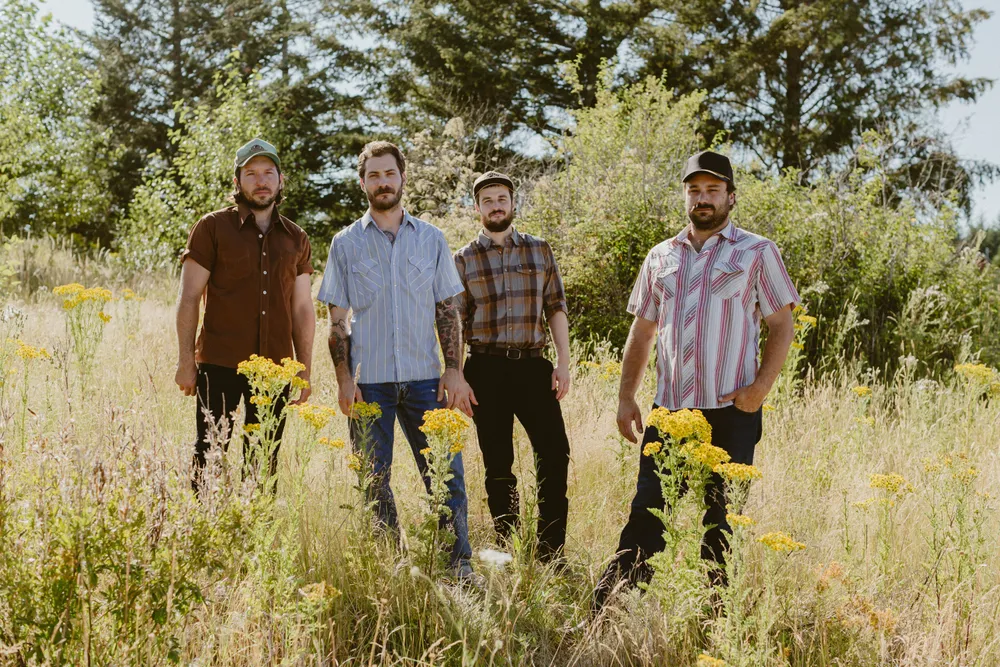
There’s an authenticity to the wear and tear of life that can’t be manufactured—it must be earned. On their debut album “Cracks,” Santa Cruz-based Americana outfit The Lowtimers deliver a collection that feels lived-in not because they’re trying to sound weathered, but because songwriters Mark Tegio and Austin Smith have put in the highway miles to earn every note. Released May 16th, these ten tracks navigate the subtle fissures that form in relationships, dreams, and identities with remarkable emotional precision.
Opening track “Flesh and Bone” immediately establishes the band’s sonic territory—a space where folk-rock meets contemporary Americana without feeling beholden to either tradition. Tegio’s vocals carry a grit that feels earned rather than affected, while the arrangement strikes perfect balance between raw emotion and careful craftsmanship. As Glide Magazine aptly noted, the track is “pure folk-rock at its finest,” with its “subtle twang” and “simplistic arrangement” creating space for the band’s poetic songwriting to breathe.

“Thunderstorms” follows with atmospheric tension, its layered guitars and rumbling percussion creating sonic equivalent of distant weather patterns. The pedal steel work adds textural depth without resorting to clichés, while the rhythm section of Andrew Dreher (upright bass) and Andrew Mohney (drums) demonstrates remarkable restraint, knowing exactly when to surge forward and when to pull back. This dynamic control becomes a hallmark throughout the album, allowing songs to build organically rather than following predictable structures.
By the time “Sleazy” arrives third in sequence, the band’s versatility becomes apparent. Here they venture into swampier territory, with Brett Robinson’s pedal steel creating eerie, cinematic backdrop for a narrative exploring life on the road as a touring musician.
The title track emerges as the album’s emotional centerpiece, its metaphor of fractures becoming pathways for light serving as perfect encapsulation of the collection’s overarching philosophy. Producer Brett Robinson of Alabama Sound Company deserves particular credit here, creating space where vocals and instrumentation complement rather than compete, resulting in a recording that feels intimate despite its textural richness.
“New Friends” shifts toward more uptempo territory without sacrificing emotional depth, its exploration of chosen family particularly resonant for a band formed through years of touring. When Austin Smith sings about finding connection in unexpected places, you hear the conviction of someone who’s built meaningful relationships in dive bars and highway stops across the country. The arrangement honors both 50s swing influences and contemporary indie-folk sensibilities, embodying the band’s ability to implement diverse musical eras without sounding derivative.
“Tired Mind,” featuring guest vocalist Kassi Valazza, offers necessary feminine counterpoint to the album’s predominantly male perspective. The duet structure creates dialogue rather than mere harmonizing, adding narrative dimension that enhances both performers’ contributions. Brett Robinson’s Wurlitzer work here is particularly noteworthy, creating haunting atmosphere that amplifies the lyrics’ exploration of mental exhaustion without resorting to melodrama.
“Charlotte,” the album’s final pre-release single, demonstrates why the band saved it for last in their promotional strategy. The track’s narrative strength and melodic accessibility make it perhaps the most immediate entry point for new listeners while still maintaining the depth that rewards repeated attention. The rhythm section shines particularly bright here, with Dreher’s upright bass and Mohney’s drums locking into groove that’s simultaneously relaxed and precise.
“Lonely Company” explores isolation’s paradoxes—how we can feel most alone surrounded by others, and find connection in solitude. The arrangement’s spaciousness creates perfect sonic embodiment of this thematic tension, with instruments occupying distinct territories that occasionally intersect in surprising ways. Smith’s vocal performance conveys vulnerability without weakness, a difficult balance that speaks to the band’s emotional maturity.
Penultimate track “Here and Gone” contemplates impermanence with clear-eyed acceptance rather than resignation. The melody’s wistful quality contrasts with the driving rhythm, creating productive tension that prevents the song from collapsing into melancholy despite its subject matter. This balanced approach to difficult emotions characterizes the album as a whole—acknowledging darkness without wallowing in it.
“Pastures” closes the collection with tentative optimism, suggesting new beginnings while honoring what’s been lost along the way. The arrangement gradually builds toward cathartic release that feels earned rather than forced, providing satisfying conclusion to an album that carefully avoids easy answers or artificial resolution.
Throughout “Cracks,” The Lowtimers demonstrate remarkable cohesion for a band often “found on the move in an oversized Ford Econoline.” Their years touring the West Coast have clearly forged both musical chemistry and shared vision that transcends individual contributions. Robinson’s production serves this collective ethos perfectly, creating sonic landscape that honors both traditional Americana textures and contemporary approaches without feeling scattered or unfocused.
What ultimately distinguishes “Cracks” from countless other Americana debuts is its emotional honesty coupled with musical restraint. The Lowtimers aren’t trying to reinvent the genre or demonstrate technical virtuosity; instead, they’re using familiar musical language to explore the nuanced experiences that shape human lives. In doing so, they’ve created something that feels both timeless and immediate—a collection that, as Last Day Deaf observed, contains “grit in the vocals, tension in the guitars, and a rawness that feels both timeless and urgent.”
For a debut album, “Cracks” demonstrates remarkable maturity and artistic vision, suggesting The Lowtimers aren’t just passing through the Americana landscape but have established permanent residence within it—even if they’re usually found somewhere on the highway between gigs, living the very experiences they so compellingly chronicle.
 B-Side Guys
Leave a Reply