
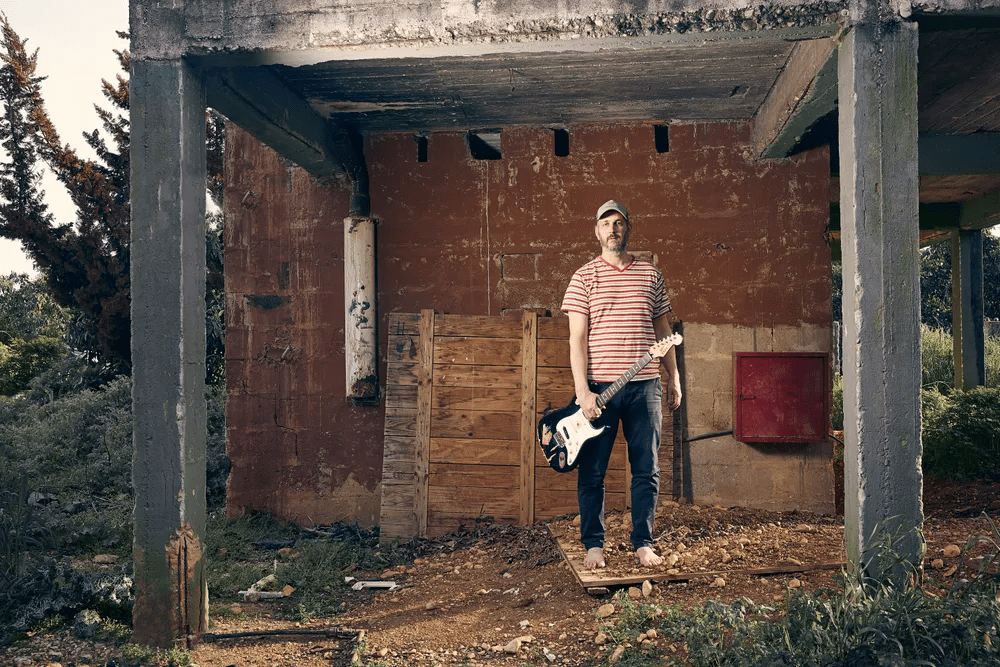
Geography often shapes art in ways both obvious and subtle. For Israeli musician Sivan Langer, the tumultuous landscape of the Galilee region provides more than mere backdrop—it infuses his debut album “ROUGH MIX” with an urgency and resilience that transcends its DIY production. Across eleven tracks and a concise thirty minutes, Langer navigates a terrain of contrasting musical territories while maintaining a cohesive artistic vision that feels defiantly personal.
The album opens with “Simple Song,” a deceptively straightforward composition that functions as both ironic commentary and genuine artistic statement. The track’s sparse arrangement highlights Langer’s gift for creating space within seemingly minimal frameworks. What initially appears to be a protest against complexity gradually reveals itself as an assertion of music’s fundamental power to provide clarity amidst chaos. This thematic foundation—finding order within disorder—continues throughout the album, reflecting Langer’s reported experience creating music in a literal war zone.

“It’s Alright” shifts the sonic palette toward more psychedelic territory while maintaining the opener’s philosophical perspective. The production here demonstrates Langer’s self-taught engineering skills, with carefully calibrated reverb creating dimensional depth that belies the project’s resource limitations. Rather than attempting to disguise these constraints, Langer transforms them into aesthetic assets, embracing imperfections as essential components of authentic expression.
“Three Monkey Song” represents the album’s most polished moment, benefiting from the mixing expertise of Grammy-winning engineer Darrell Thorp (known for his work with Radiohead and Beck). The track’s satirical examination of willful ignorance showcases Langer’s lyrical approach—direct yet metaphorical, politically charged without descending into didacticism. The contrast between Thorp’s professional mix and Langer’s DIY approach on surrounding tracks creates productive tension rather than inconsistency, suggesting that artistic truth emerges from both technical precision and raw immediacy.
“The Second Cup” introduces jazz-influenced chord progressions that reflect Langer’s musical evolution beyond his early grunge and rock influences. The song’s structure mirrors its lyrical exploration of perception shifts, beginning with disorientation before achieving unexpected clarity. This compositional approach—using musical structure to reinforce lyrical themes—demonstrates Langer’s sophisticated understanding of songwriting as multidimensional communication.
By the album’s midpoint, “Salvador” offers a brief instrumental interlude that showcases Langer’s guitar proficiency without sacrificing the album’s focus on composition over virtuosity. The track’s surrealist atmosphere (suggested by its titular reference to Dalí) creates necessary breathing room before the album’s more confrontational second half.
“Alibi” emerges as perhaps the album’s most immediately accessible track, with its insistent rhythm and memorable chorus examining themes of deception and self-delusion. What distinguishes the song from standard rock fare is Langer’s vocal delivery, which maintains emotional intensity while avoiding melodramatic excess. This restraint characterizes the entire album, suggesting an artist more concerned with communication than performance.
The album’s final sequence—”Races,” “Barbarians,” “Can’t Stand,” and “Let’s Rock It”—creates accelerating momentum that mirrors Langer’s artistic journey from contemplation to assertion. “Barbarians” in particular demonstrates his ability to channel righteous anger without surrendering to it completely, maintaining the critical distance necessary for effective commentary. The production choices throughout this sequence emphasize raw energy over polish, creating an experience that feels increasingly live and immediate.
Closing track “World Unite” provides both thematic resolution and new possibilities, suggesting that connection remains possible even in divided landscapes. The arrangement gradually incorporates elements from preceding tracks, creating a sense of accumulation rather than conclusion—as if the album represents not a finished statement but a foundation for continued artistic exploration.
Throughout “ROUGH MIX,” what impresses most is Langer’s refusal to allow circumstantial limitations to determine artistic outcomes. By embracing the DIY aesthetic as philosophical statement rather than mere necessity, he creates work that feels genuinely independent—not in the genre-marketing sense but in its determination to exist on its own terms. The album’s title itself functions as both description and declaration, acknowledging imperfection while asserting its value.
For listeners accustomed to frictionless production, “ROUGH MIX” offers a necessary reminder of music’s potential as both personal salvation and cultural intervention. Langer has created something increasingly rare in contemporary music—art that bears witness to its difficult genesis without being defined by it. The result is an album that functions simultaneously as political statement and personal testimony, artistic exploration and emotional catharsis.
The fact that singles from this collection have garnered attention from major streaming platforms (including appearances on editorial playlists from Apple Music, Spotify, and Pandora) suggests that authentic expression still finds audience despite algorithm-driven distribution. For an artist creating in challenging circumstances, this recognition represents not just validation but vital connection—proof that music can indeed transcend borders both geographical and ideological. With “ROUGH MIX,” Sivan Langer doesn’t just demonstrate promising talent; he affirms music’s enduring power as cultural resistance.
 B-Side Guys
Leave a Reply