
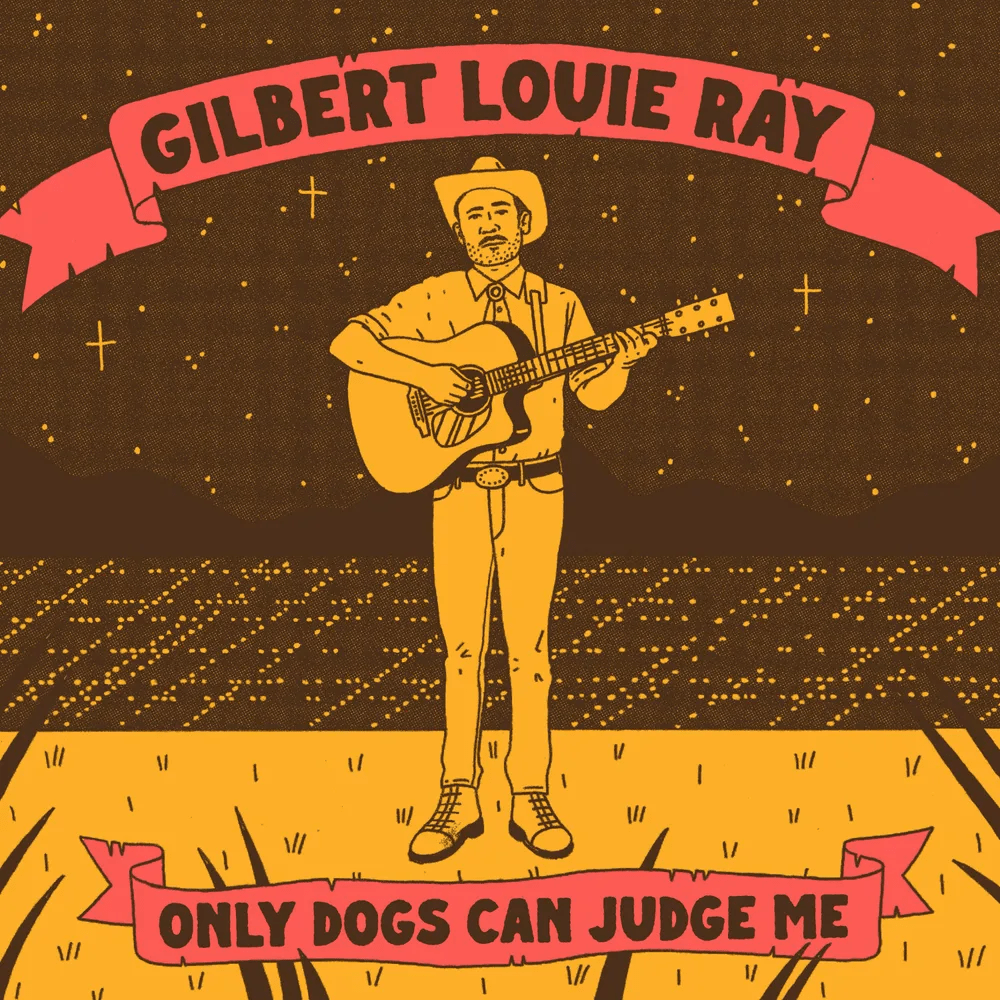
The barroom confession has been a cornerstone of American music since Hank Williams first poured his sorrows into a microphone. On “Only Dogs Can Judge Me,” Gilbert Louie Ray reimagines this tradition for contemporary listeners without sacrificing its essential honesty. The Atwater Village, California native’s twelve-track collection isn’t interested in polished narratives or Instagram-ready redemption arcs—instead, it wallows gloriously in the murky waters of bad decisions, morning-after regrets, and the stubborn hope that somehow keeps us moving forward.
From the album’s title alone, Ray signals his intent. There’s a wry self-awareness here, a recognition that while human judgment comes loaded with hypocrisy, our canine companions offer something purer. This theme of being seen—truly seen—weaves throughout the album’s sonic tapestry of bluegrass, folk, country, and Americana elements.
“Her Company” opens the collection with unexpected buoyancy, fiddle and mandolin dancing around one another as Ray introduces us to his distinctive vocal delivery. His voice isn’t conventionally pretty; it’s something better—authentic, with a reedy tremor that conveys emotional fragility beneath surface bravado. When he sings about preferring a woman’s presence to his own thoughts, the sentiment lands without a hint of sentimentality.
The album’s sequencing creates a narrative flow that mirrors a night of heavy drinking—starting with anticipation, moving through various emotional states, and eventually reaching bleary-eyed clarity. “The DWP” and “DUI” form bookends of this progression, both addressing consequences with different levels of resignation. The latter track stands out particularly for its unflinching examination of recklessness, set against a deceptively jaunty arrangement.
“Close but No Cigar” occupies the album’s emotional center despite its early placement. Here, Ray’s storytelling abilities shine brightest as he chronicles near-misses in love and life. The song’s bridge—where instruments drop out briefly to spotlight his voice—creates a moment of startling intimacy, as if the bar has suddenly emptied and we’re alone with the singer’s confessions.
Musicians Billy Lupton (mandolin), Patrick Torrez (bass), and Phoebe Silva (fiddle) deserve special recognition for their contributions. Throughout the album, they provide more than mere accompaniment; they create conversational counterpoints to Ray’s vocals. On “Go as You Please,” Silva’s fiddle weaves a countermelody that functions almost as another voice, answering Ray’s lyrics with its own emotional commentary.
“What I Have Left” emerges as the album’s standout track, a perfect distillation of Ray’s artistic approach. The opening line—”Pour me up a glass of whiskey or wine / I’m here all night and I’m here to unwind”—establishes both setting and emotional state with remarkable economy. As the song progresses, Ray unpacks a post-breakup inventory of emotional resources, concluding that self-preservation requires letting go. The band’s performance elevates the material, creating a sturdy framework that supports but never overshadows Ray’s vulnerable delivery.
The album’s second half turns slightly more reflective, with “Meet You Halfway” exploring compromise with hard-earned wisdom. “Hey My Old Friend” offers a welcome change of perspective, addressing a long-absent companion with complicated fondness. The track’s gentle waltz time signature creates a nostalgic sway that perfectly complements its lyrical content.
“An Adulterous Song” stands as the album’s most provocative moment, not for explicit content but for its refusal to offer easy moral judgments. Ray examines infidelity from multiple angles, acknowledging culpability while resisting simplistic narratives of villainy. The song’s arrangement—sparse verses building to a more instrumented chorus—mirrors its thematic complexity.
Penultimate track “All I Wanna Say” initially suggests a straightforward love song before revealing itself as something more complex—an examination of communication failures and the things left unspoken. The album then concludes with “New Faces,” which looks forward with cautious optimism, suggesting that while patterns may repeat, change remains possible.
Production throughout “Only Dogs Can Judge Me” strikes an ideal balance between polish and rawness. The instruments occupy distinct spaces in the mix while maintaining a cohesive sound that recalls live performance. This approach serves Ray’s material perfectly, creating intimacy without sacrificing clarity.
What distinguishes this collection is its emotional honesty. Ray isn’t interested in portraying himself as hero or villain, wise sage or cautionary tale. Instead, he occupies the messy middle ground where most of us actually live—making mistakes we recognize, repeating patterns we understand, and occasionally finding moments of connection that make it all worthwhile.
For listeners tired of artificial narratives and curated authenticity, “Only Dogs Can Judge Me” offers something increasingly rare: a genuine artistic voice speaking difficult truths through the timeless language of American roots music. Gilbert Louie Ray has created a collection that honors tradition while bringing his distinct perspective to bear on universal experiences of love, loss, and self-destruction. In doing so, he reminds us that judgment—human judgment, at least—is often beside the point. The dogs already know who we really are, and they love us anyway.
 B-Side Guys
Leave a Reply