
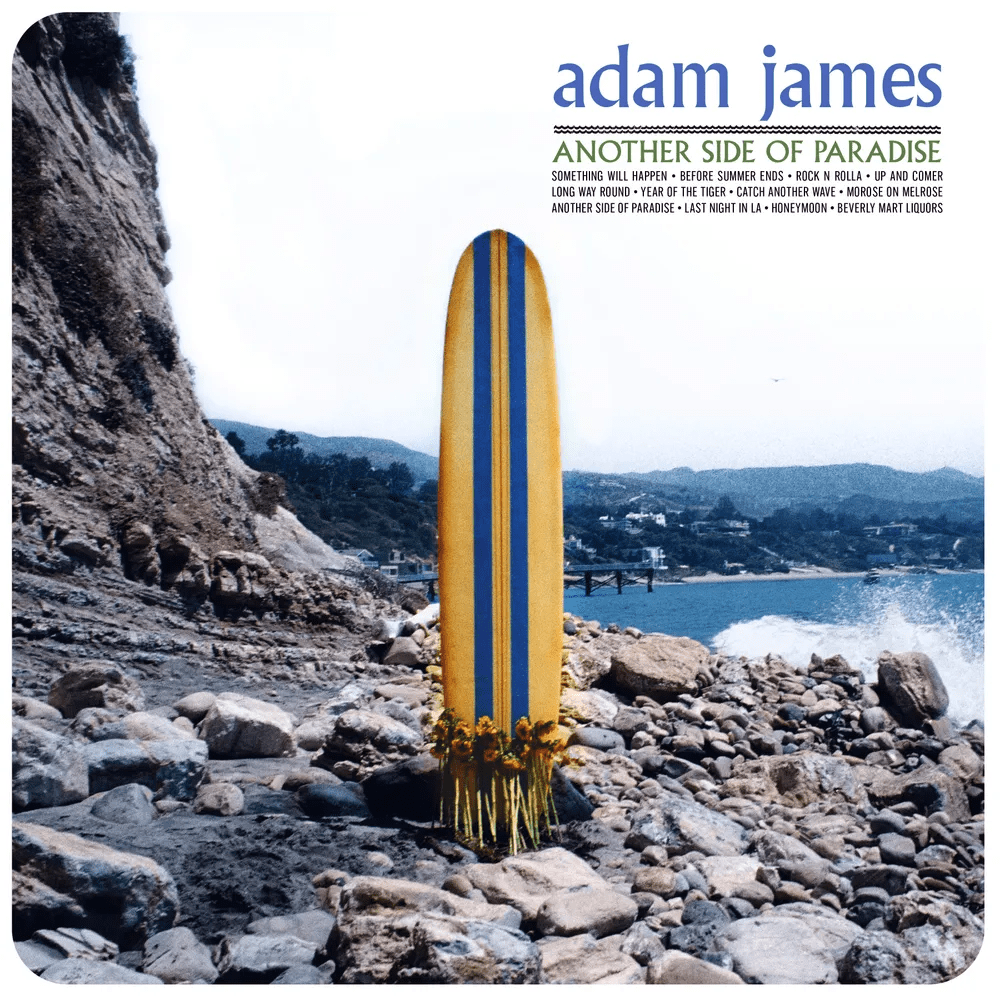
The distance between Hollywood and Nashville shapes every moment of “Another Side of Paradise,” where Adam James and producer Steve Stout turned bicoastal file sharing into creative advantage. Their back-and-forth process – trading tracks between James’s Hollywood studio and Stout’s Nashville base – creates fascinating tension between California pop history and contemporary indie production across twelve songs that examine Los Angeles’s contradictions.
James’s evolution from east coast post-hardcore stages to west coast songwriting informs these arrangements in surprising ways. “Something Will Happen” demonstrates how his time with Sleep Bellum Sonno influences even sunny pop constructions – vocal harmonies stack with mathematical precision while guitars build tension through careful layering rather than simple strumming. Stout’s production captures both the song’s immediacy and its underlying complexity.
“Before Summer Ends” reveals James’s skill at incorporating diverse influences without losing focus. His vocal approach draws from both The Beatles’ melodic sensibilities and Conor Oberst’s intimate delivery, while the arrangement references Beach House’s dream pop textures through vintage equipment choices. The mix creates distinct spaces for each element while maintaining natural blend.
On “Rock N Rolla” and “Up and Comer,” James examines Los Angeles’s entertainment industry mythology through specific details rather than broad strokes. His lyrics focus on quiet moments between the usual narratives, while the production supports these stories through careful sonic placement. Each instrument occupies frequencies that suggest physical and emotional distance without sacrificing overall cohesion.
The album’s middle section demonstrates sophisticated understanding of how different studios shape sound. “Long Way Round” captures Hollywood room ambience through strategic microphone placement, while “Year of the Tiger” employs Nashville’s precise approach to instrument separation. These contrasting techniques create dynamic range that serves the songs’ themes of displacement and adaptation.
James’s work with prog-punk outfit The Vigilance Committee influences the album’s structural choices. “Catch Another Wave” shifts time signatures subtly beneath pop melodies, while complex vocal harmonies reference both The Beach Boys and Death Cab for Cutie. This combination of technical complexity and emotional directness runs throughout the record’s arrangements.
“Morose on Melrose” provides the clearest example of how James and Stout use production to enhance narrative. The verses employ close microphone techniques that capture performance nuances, while choruses expand into wider stereo fields that suggest urban vastness. These technical decisions support the song’s examination of isolation within crowds.
The title track, featuring Stout on backing vocals, demonstrates how file sharing can enhance rather than hinder collaboration. Their harmonies weave through arrangements that acknowledge multiple eras of California pop while establishing distinct identity. The production creates specific space for each vocal part through careful EQ and compression choices that allow natural blend while maintaining clarity.
James’s experience leading More Than Skies informs the folk-rock elements throughout these recordings. “Last Night in LA” and “Honeymoon” incorporate acoustic textures learned from that project, while adding production touches that expand their sonic palette. The mixing approaches differ significantly – “Last Night” employs distance and reverb to suggest emotional removal, while “Honeymoon” captures intimate performance details through close microphone placement.
When writing “Another Side of Paradise,” James deliberately chose Paradise Cove’s connection to Beach Boys history, positioning his Cordoba guitar at the site of their first album cover. This concrete connection to California pop history shapes the album’s production choices without overwhelming them. Rather than simply mimicking 1960s techniques, James and Stout reference them through contemporary approaches to recording and arrangement.
Closing track “Beverly Mart Liquors” synthesizes the album’s various elements while introducing new textures. The arrangement incorporates James’s post-hardcore dynamics, prog-punk compositional complexity, and folk-rock intimacy while maintaining pop accessibility. Each new element enters with purpose, creating build through accumulation rather than obvious dynamic shifts.
Throughout these forty-six minutes, James and Stout demonstrate remarkable ability to reference multiple styles while creating something cohesive. Their collaboration process allows both Nashville studio precision and Hollywood bedroom pop intimacy to inform the production approach. Each track benefits from this dual perspective, creating sonic spaces that feel both carefully constructed and naturally evolving.
The album’s sequencing reveals sophisticated understanding of how different production approaches affect listener experience. Each song occupies distinct frequency ranges that prevent fatigue while maintaining engagement. This attention to technical detail reflects both James’s years of recording experience and Stout’s production expertise.
“Another Side of Paradise” succeeds not just as collection of California-inspired songs but as examination of how geography shapes musical identity. James’s journey from east coast stages through various bands to west coast studios informs every aspect of these recordings. The result captures an artist engaging thoughtfully with multiple traditions while establishing his own distinct voice.
His upcoming album release celebration at Gold Diggers in East Hollywood feels particularly appropriate – a venue that, like these recordings, bridges Los Angeles music history with contemporary indie sensibilities. These twelve tracks suggest an artist who understands California pop’s legacy while refusing to be limited by it, creating something both historically informed and urgently current.
 B-Side Guys
Leave a Reply